

2026 Windstorm Engineering Cheat Sheet TX NC FL
Updated: Sep 28

Why Choose JRH Engineering
Why Developers, Contractors & Property Owners Choose JRH
Most engineering firms talk about technical capability. We focus on what actually matters to your project: speed, cost, communication, and results.
Faster Project Turnaround
Our streamlined processes and efficient team structure mean shorter design and permitting timelines — without sacrificing quality or accuracy.
Clear & Responsive Communication
You work directly with engineers who keep you informed. No long delays or unanswered emails — just straightforward updates and quick responses.
Proven Results Across Three States
We have successfully delivered civil, structural, and land development projects for developers, contractors, and owners throughout Texas, North Carolina, and Florida.
Check out JRH's case studies.
Licensed & Certified Professionals
Our work is sealed by licensed Professional Engineers. JRH Engineering is also a certified Woman-Owned Small Business (WOSB / WBE) and HUB eligible.
What Windstorm Engineering Covers
Windstorm engineering designs a building to resist hurricane and high-wind loads, from the roof down through the walls to the foundation.
Design wind speed and pressure depend on the exact site, building risk category and exposure, so they come from the adopted code and ASCE 7 for your address, not a regional average.
JRH Engineering is a Structural Engineer, Civil Engineer and Land Development firm serving Texas, North Carolina and Florida.
JRH guiding principles are: Engineering Excellence. Delivered on Time. Built on Value.
Key Terms
Risk category: how critical the building is, from low-risk structures to essential facilities
Exposure category: the surrounding terrain, such as B for urban or suburban, C for open terrain and D for flat, unobstructed shorelines
Components and cladding: roof, wall and opening pressures, which are often highest at corners and edges
Continuous load path: connections that carry uplift from the roof to the foundation
Windstorm Checklist
Confirm the adopted code edition and design wind speed for the site
Size roof-to-wall and wall-to-foundation connections
Specify product-approved windows, doors and roofing where required
Plan inspections before walls and roofs are covered
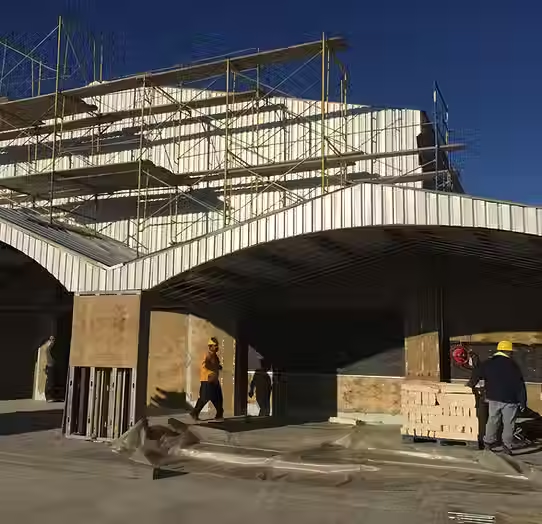
Project: Wedding Venue Chapel & Main Building, Friendswood, TX
Chapel and main building for a wedding venue in Friendswood, Galveston County
Coastal location requiring windstorm certification
Read the full Friendswood wedding venue case study
Challenges
Large window openings left too little continuous wall for code-compliant wood shear walls
Open interiors ruled out conventional ceiling joists
The building needed windstorm certification for insurance
Objectives
Resolve lateral support at the large window walls.
Deliver open interiors with a continuous load path.
Support windstorm certification.
Solutions JRH Engineering Provided
Complete structural engineering plan set for permit and construction
Truss roof framing in place of conventional ceiling joists
Structural steel columns in the walls and steel end-wall framing for lateral support
Windstorm inspection services supporting Texas Windstorm Insurance Association certification
Results:
Shear wall capacity resolved at the large windows
Open-ceiling interiors achieved
Windstorm certification obtained
Windstorm Requirements in Texas, North Carolina and Florida
Texas
Per the Texas Department of Insurance, coastal properties must meet certain building standards to get windstorm insurance.
TDI's windstorm program lists the 2024 IRC and IBC as current, effective April 1, 2026.
JRH provides WPI-8 windstorm certification in Brazoria and Galveston counties only; see Understanding the WPI-8 Form in Texas.
North Carolina
The NC Office of State Fire Marshal lists the 2018 NC codes as current, with 2024 pending.
Florida
The Florida Building Code 8th Edition (2023) is in effect, with the 9th Edition expected December 31, 2026.
Miami-Dade and Broward counties are in the High-Velocity Hurricane Zone (HVHZ), with stricter product approval rules.
Frequently Asked Questions
What is windstorm engineering?
Designing a building's roof, walls, openings and connections to resist hurricane and high-wind loads.
How is design wind speed determined?
From the adopted building code and ASCE 7 for the site, based on location and risk category.
What is a WPI-8?
A Texas windstorm certificate of compliance used for windstorm insurance eligibility on the coast.
Which Texas code editions does TDI's windstorm program use?
TDI lists the 2024 IRC and IBC, effective April 1, 2026.
Does JRH Engineering provide WPI-8 certification?
Yes, JRH Engineering provides WPI-8 windstorm certification in Brazoria and Galveston counties only.
Does JRH Engineering obtain building permits?
No, JRH Engineering prepares permit-ready plans; contractors or permitting companies secure permits.
Want More Information on this Topic?
Call JRH Engineering at (800) 227-9635
Use the chatbot in the lower right-hand corner of this page
Submit a request through JRH Engineering's contact page
Find JRH Engineering on Google:
This article was written by the team at JRH Engineering, a licensed engineering firm with 18 years of experience in civil, structural, and land development. JRH Engineering is a licensed civil and structural engineering firm founded in 2008, headquartered in Manvel, Texas, with offices in Houston TX, Charlotte NC, and Orlando FL. Certified WBE, WOSB, and HUB-eligible. Phone: (800) 227-9635 | sales@jrhengineering.net | jrhengineering.net. Texas PE license is F-10385. North Carolina PE license is P-3118. Florida license is 38516.



Comments