


FEMA Draft Flood Maps for Harris County: What It Means for Your Project
Updated: 4 days ago

Why Choose JRH Engineering
Why Developers, Contractors & Property Owners Choose JRH
Most engineering firms talk about technical capability. We focus on what actually matters to your project: speed, cost, communication, and results.
Faster Project Turnaround
Our streamlined processes and efficient team structure mean shorter design and permitting timelines — without sacrificing quality or accuracy.
Clear & Responsive Communication
You work directly with engineers who keep you informed. No long delays or unanswered emails — just straightforward updates and quick responses.
Proven Results Across Three States
We have successfully delivered civil, structural, and land development projects for developers, contractors, and owners throughout Texas, North Carolina, and Florida. Check out JRH's case studies.
Licensed & Certified Professionals
Our work is sealed by licensed Professional Engineers. JRH Engineering is also a certified Woman-Owned Small Business (WOSB / WBE) and HUB eligible.
What Harris County's Draft Flood Maps Mean Right Now
Harris County's new flood maps are still in draft through the MAAPnext program.
When FEMA releases them as preliminary maps, they can change flood insurance, finished floor elevations and site layout across the county.
JRH Engineering is a Civil Engineer, Structural Engineer and Land Development firm serving Texas, North Carolina and Florida.
JRH guiding principles are: Engineering Excellence. Delivered on Time. Built on Value.
Where the Harris County Maps Stand
Per MAAPnext:
The draft maps are shared for informational and educational purposes only
They cannot be used for insurance or regulatory decisions and are not open for public comment
FEMA is expected to release preliminary Flood Insurance Rate Maps (FIRMs) after its federal review
A formal public review and appeal period follows that release
Until then, the current effective maps on FEMA's Flood Map Service Center still govern permits and insurance.
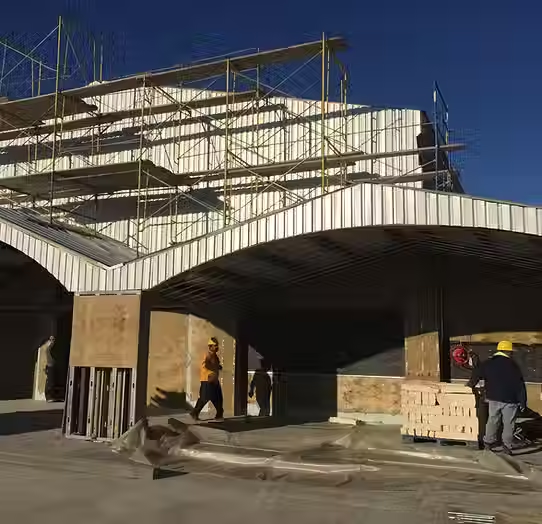
Project: Underground Detention Pond for a Floodplain Expansion, Channelview, TX
Industrial warehouse building expansion in the floodplain in Channelview, Harris County
Reviewed by the Harris County Flood Control District (HCFCD)
Read the full Channelview case study
Challenges
HCFCD required detention pond storage for the new impervious area
The site had no room for an above-ground detention pond
Operations had to keep running during design and permitting
Objectives
Provide the required floodplain storage volume.
Keep the full site usable for industrial operations.
Support HCFCD floodplain permit approval.
Solutions JRH Engineering Provided
Complete civil engineering design for the building expansion
An underground detention pond system sized to HCFCD requirements
Capacity calculations and permitting documentation for HCFCD review
Results:
No surface area used for detention pond storage
HCFCD floodplain permit issued
Existing operations continued throughout permitting
Planning Ahead of the New Maps
Screen sites against both the effective maps and the MAAPnext drafts
Budget for higher finished floors and more detention pond storage near bayous and channels
Design foundations for flood loads where a site may move into a Special Flood Hazard Area
Flood Map Updates in Texas, Florida and North Carolina
Texas
Space-constrained Harris County sites have other options, such as the backfill detention pond system JRH used on the Aldine Westfield office warehouse.
Florida
Lee County received a Letter of Final Determination from FEMA in September 2026, with new maps effective March 2, 2027.
See our Florida FEMA flood map updates post for more.
North Carolina
North Carolina flood maps and data are published through NC Emergency Management's Flood Risk Information System.
JRH has no published North Carolina floodplain case study yet.
Frequently Asked Questions
Are Harris County's new FEMA flood maps in effect?
No, the MAAPnext maps are drafts and cannot be used for insurance or regulatory decisions.
Can I comment on the Harris County draft flood maps?
Not yet; a formal public review and appeal period follows FEMA's release of preliminary maps.
Which flood maps apply to my permit today?
The current effective FEMA maps, which you can check on FEMA's Flood Map Service Center.
Can a floodplain site without room for a pond still expand?
Yes, JRH Engineering used an underground detention pond system on a Channelview industrial expansion.
Which agency reviewed floodplain storage on the Channelview project?
The Harris County Flood Control District reviewed the Channelview project's floodplain storage.
Does JRH Engineering obtain building permits?
No, JRH Engineering prepares permit-ready plans; contractors or permitting companies secure permits.
Want More Information on this Topic?
Call JRH Engineering at (800) 227-9635
Use the chatbot in the lower right-hand corner of this page
Submit a request through JRH Engineering's contact page
Find JRH Engineering on Google:
This article was written by the team at JRH Engineering, a licensed engineering firm with 18 years of experience in civil, structural, and land development. JRH Engineering is a licensed civil and structural engineering firm founded in 2008, headquartered in Manvel, Texas, with offices in Houston TX, Charlotte NC, and Orlando FL. Certified WBE, WOSB, and HUB-eligible. Phone: (800) 227-9635 | sales@jrhengineering.net | jrhengineering.net. Texas PE license is F-10385. North Carolina PE license is P-3118. Florida license is 38516.



Comments