

Florida Metal Building Permits & Wind Load Rules 2026
Updated: 2 days ago

Why Choose JRH Engineering
Why Developers, Contractors & Property Owners Choose JRH
Most engineering firms talk about technical capability. We focus on what actually matters to your project: speed, cost, communication, and results.
Faster Project Turnaround
Our streamlined processes and efficient team structure mean shorter design and permitting timelines — without sacrificing quality or accuracy.
Clear & Responsive Communication
You work directly with engineers who keep you informed. No long delays or unanswered emails — just straightforward updates and quick responses.
Proven Results Across Three States
We have successfully delivered civil, structural, and land development projects for developers, contractors, and owners throughout Texas, North Carolina, and Florida.
Check out JRH's case studies.
Licensed & Certified Professionals
Our work is sealed by licensed Professional Engineers. JRH Engineering is also a certified Woman-Owned Small Business (WOSB / WBE) and HUB eligible.
Why Florida Metal Building Rules Are Different
Florida metal buildings have to resist hurricane wind, uplift and, in many areas, wind-borne debris.
For 2026 permits, design follows the Florida Building Code 8th Edition (2023) and the ASCE 7-22 wind provisions it references.
JRH Engineering is a Structural Engineer, Civil Engineer and Land Development firm serving Texas, North Carolina and Florida.
JRH guiding principles are: Engineering Excellence. Delivered on Time. Built on Value.
What Sets the Wind Load
The site's basic wind speed from the code wind maps
Risk category, exposure category and building height
Whether the building is enclosed, partially enclosed or open
Roof slope and component size for cladding pressures
What a Permit Package Typically Includes
Signed and sealed structural drawings by a Florida-licensed engineer
Wind load criteria and calculations
Florida Product Approval numbers for doors, windows, roofing and cladding
A foundation plan with anchor bolt layout
A site plan and the local permit application
High-Velocity Hurricane Zone
The HVHZ covers Miami-Dade and Broward counties
Components need approvals that meet HVHZ rules, and reviews are stricter
Common Permit Delays
Drawings sealed by an engineer not licensed in Florida
Missing or wrong product approval numbers
Wind speed or exposure category set incorrectly
A foundation not matched to site soils
Local code amendments overlooked
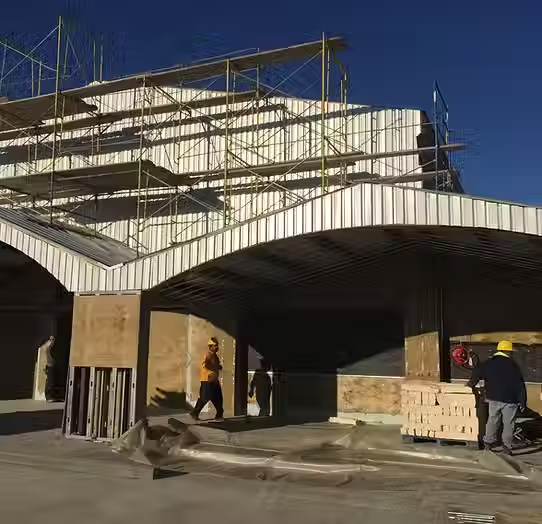
Project: Metal Building Foundation, Montgomery, TX
This Texas project shows the same foundation and anchorage coordination a Florida metal building permit needs.
120 ft x 70 ft metal building in Montgomery, Montgomery County, TX
Structural plans completed December 2025
Challenges
Column anchor bolts had to match the metal building manufacturer's design
The slab, grade beams and footings had to work as one system
Objectives
Deliver a foundation plan the contractor could build from without guesswork.
Coordinate anchorage with the building supplier.
Solutions JRH Engineering Provided
Structural engineering foundation plan and details
Reinforced grade beams with 4 ft x 4 ft and 5 ft x 5 ft column footings
Four 3/4-inch ASTM F1554 anchor bolts at each column, noted to verify with the manufacturer
Component and cladding wind pressures on the plans
Results:
PE-sealed foundation package ready for permitting
Anchorage coordinated with the metal building supplier
Metal Buildings in Florida, Texas and North Carolina
Florida
See the Florida Building Code and FEMA Building Science hurricane resources; also see 2026 Windstorm Design for Tampa & Panhandle.
Texas
North Carolina
The NC Office of State Fire Marshal lists the 2018 NC codes as current, with 2024 pending.
Frequently Asked Questions
Do Florida metal buildings need sealed engineering?
Building departments typically require signed and sealed structural drawings by a Florida-licensed engineer.
Which code governs Florida metal building wind design?
The Florida Building Code 8th Edition (2023), which references ASCE 7-22.
What is Florida Product Approval?
State approval showing a product such as a door or roof panel meets code for its rated loads.
Which Florida counties are in the HVHZ?
Miami-Dade and Broward counties.
How large a metal building foundation does JRH Engineering design?
JRH Engineering designs metal building and PEMB foundations up to 120,000 SF.
Does JRH Engineering obtain building permits?
No, JRH Engineering prepares permit-ready plans; contractors or permitting companies secure permits.
Want More Information on this Topic?
Call JRH Engineering at (800) 227-9635
Use the chatbot in the lower right-hand corner of this page
Submit a request through JRH Engineering's contact page
Find JRH Engineering on Google:
This article was written by the team at JRH Engineering, a licensed engineering firm with 18 years of experience in civil, structural, and land development. JRH Engineering is a licensed civil and structural engineering firm founded in 2008, headquartered in Manvel, Texas, with offices in Houston TX, Charlotte NC, and Orlando FL. Certified WBE, WOSB, and HUB-eligible. Phone: (800) 227-9635 | sales@jrhengineering.net | jrhengineering.net. Texas PE license is F-10385. North Carolina PE license is P-3118. Florida license is 38516.



Comments