


How to Profit from an ADU in 2026 in Texas, North Carolina, and Florida
Updated: 7 days ago

Why Choose JRH Engineering
Why Developers, Contractors & Property Owners Choose JRH
Most engineering firms talk about technical capability. We focus on what actually matters to your project: speed, cost, communication, and results.
Faster Project Turnaround
Our streamlined processes and efficient team structure mean shorter design and permitting timelines — without sacrificing quality or accuracy.
Clear & Responsive Communication
You work directly with engineers who keep you informed. No long delays or unanswered emails — just straightforward updates and quick responses.
Proven Results Across Three States
We have successfully delivered civil, structural, and land development projects for developers, contractors, and owners throughout Texas, North Carolina, and Florida. Check out JRH's case studies.
Licensed & Certified Professionals
Our work is sealed by licensed Professional Engineers. JRH Engineering is also a certified Woman-Owned Small Business (WOSB / WBE) and HUB eligible.
Where ADU Profit Really Starts
An accessory dwelling unit (ADU), such as a garage apartment, backyard cottage or attached suite, can add rental income or space for family.
Whether it pays off depends less on finishes and more on what the lot allows: setbacks, utilities, drainage and foundation conditions.
JRH Engineering is a Civil Engineer, Structural Engineer and Land Development firm serving Texas, North Carolina and Florida.
JRH guiding principles are: Engineering Excellence. Delivered on Time. Built on Value.
Check the Lot Before You Design
Local rules: whether the city or county allows an ADU, and its size, height, parking and owner-occupancy limits
Deed restrictions: HOA or deed rules that may be stricter than the city
Utilities: whether water, sewer or septic can serve a second unit (septic design by others)
Drainage: added roof and paving can trigger local stormwater review
Floodplain: mapped flood zones can raise the required finished floor
Engineering Decisions That Protect Your Return
A foundation designed for the soils and any connection to the existing house
Framing and wind design that match the local code
Grading that keeps water away from both buildings
Utility routing planned before the slab is poured
Ways Owners Use an ADU
Long-term rental where local rules allow
Housing for family members
Home office or guest space that adds flexibility
Project: Beckley Road Infill Townhouses, Houston, TX
This small-lot Houston project shows the same site constraints that decide whether an extra unit fits.
Sub-acre townhouse infill site in Houston, Harris County
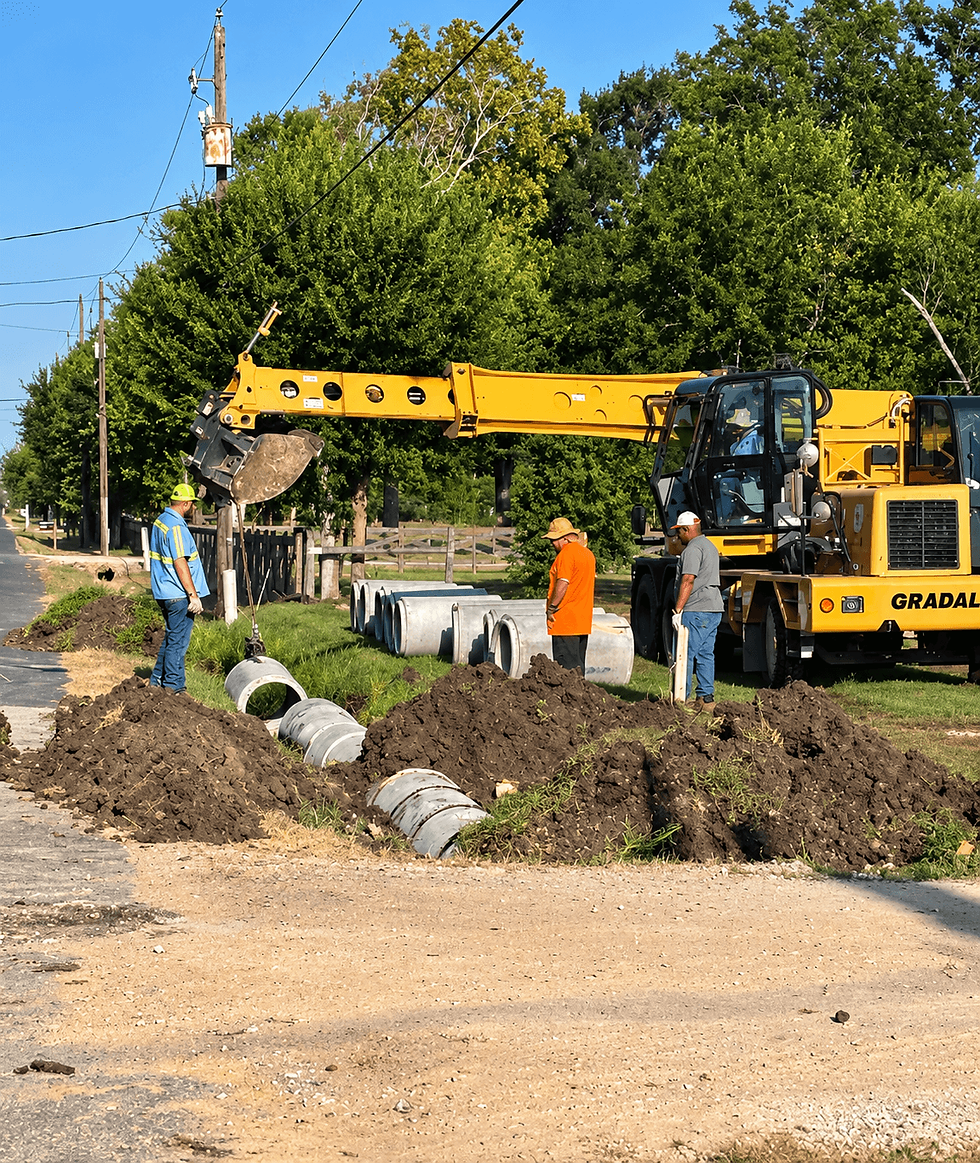
City of Houston permitting, with utility connections in a roadside ditch neighborhood
Read the full Beckley Road case study
Challenges
No room for a surface detention pond without using the development footprint
Utility connections had to meet City right-of-way standards
Objectives
Maximize usable surface area for the units.
Meet detention pond requirements without a surface pond.
Solutions JRH Engineering Provided
Civil engineering and site development design
An underground detention pond system sized to qualify for a favorable City detention pond threshold
Full plan-and-profile drawings for water, sanitary and storm connections
Results:
All surface area kept for development
Lower required storage and construction cost
Right-of-way submittal accepted on the first review cycle
ADUs in Texas, North Carolina and Florida
Texas
ADU rules are set by each city and by deed restrictions; see Does City of Houston Have Zoning? and the Texas State Law Library on residential codes.
North Carolina
Towns and counties regulate ADUs under G.S. Chapter 160D; rural lots often depend on septic approval.
Florida
The Florida Building Code 8th Edition (2023) is in effect, and flood zones on FEMA's Flood Map Service Center can set the ADU floor elevation.
Frequently Asked Questions
Can I build an ADU on my lot?
It depends on your city or county rules, deed restrictions, utilities and flood zone.
Does an ADU need engineered plans?
Many building departments require sealed foundation and framing plans, especially on expansive soils or in wind zones.
Can an ADU affect drainage?
Yes, new roof and paving area can trigger local stormwater or detention pond review.
Does JRH Engineering design ADU foundations?
Yes, JRH Engineering designs residential foundations and framing, from additions to large custom homes.
Does JRH Engineering design septic systems?
No, septic design is by others; JRH coordinates the site layout around it.
Does JRH Engineering obtain building permits?
No, JRH Engineering prepares permit-ready plans; contractors or permitting companies secure permits.
Want More Information on this Topic?
Call JRH Engineering at (800) 227-9635
Use the chatbot in the lower right-hand corner of this page
Submit a request through JRH Engineering's contact page
Find JRH Engineering on Google:
This article was written by the team at JRH Engineering, a licensed engineering firm with 18 years of experience in civil, structural, and land development. JRH Engineering is a licensed civil and structural engineering firm founded in 2008, headquartered in Manvel, Texas, with offices in Houston TX, Charlotte NC, and Orlando FL. Certified WBE, WOSB, and HUB-eligible. Phone: (800) 227-9635 | sales@jrhengineering.net | jrhengineering.net. Texas PE license is F-10385. North Carolina PE license is P-3118. Florida license is 38516.




Comments