


Land Development in Florida 2026: Full Permitting Guide
Updated: Oct 4

Why Choose JRH Engineering
Why Developers, Contractors & Property Owners Choose JRH
Most engineering firms talk about technical capability. We focus on what actually matters to your project: speed, cost, communication, and results.
Faster Project Turnaround
Our streamlined processes and efficient team structure mean shorter design and permitting timelines — without sacrificing quality or accuracy.
Clear & Responsive Communication
You work directly with engineers who keep you informed. No long delays or unanswered emails — just straightforward updates and quick responses.
Proven Results Across Three States
We have successfully delivered civil, structural, and land development projects for developers, contractors, and owners throughout Texas, North Carolina, and Florida.
Check out JRH's case studies.
Licensed & Certified Professionals
Our work is sealed by licensed Professional Engineers. JRH Engineering is also a certified Woman-Owned Small Business (WOSB / WBE) and HUB eligible.
How Land Development Permitting Works in Florida
Florida land development is reviewed by the city or county, a water management district or FDEP, and sometimes FDOT.
Projects move fastest when each review is planned before you buy the land.
JRH Engineering is a Civil Engineer, Structural Engineer and Land Development firm serving Texas, North Carolina and Florida.
JRH guiding principles are: Engineering Excellence. Delivered on Time. Built on Value.
Stage 1: Site Feasibility Before You Close
FEMA flood zone and base flood elevation
Environmental Resource Permit (ERP) jurisdiction
Wetlands (delineated by others), utilities, zoning, topography and access
The goal is a go/no-go decision with preliminary civil costs before you commit to the land.
Stage 2: Civil Engineering and Site Plans
Site plan, grading and drainage design
Stormwater management, including detention pond or retention design
Utility layouts, driveways, SWPPP and subdivision plans
Stage 3: ERP and Stormwater Compliance
ERPs are processed by FDEP district offices or one of five water management districts. The districts review most residential and commercial projects
Which district reviews a site depends on its location. For example, the South Florida Water Management District covers Lee, Collier and Miami-Dade counties
Sites that disturb 1 acre or more, or are part of a larger common plan, need FDEP construction stormwater coverage and a SWPPP. The notice of intent must be filed at least 2 days before construction
Stage 4: Structural Engineering for Vertical Construction
Foundation and framing design
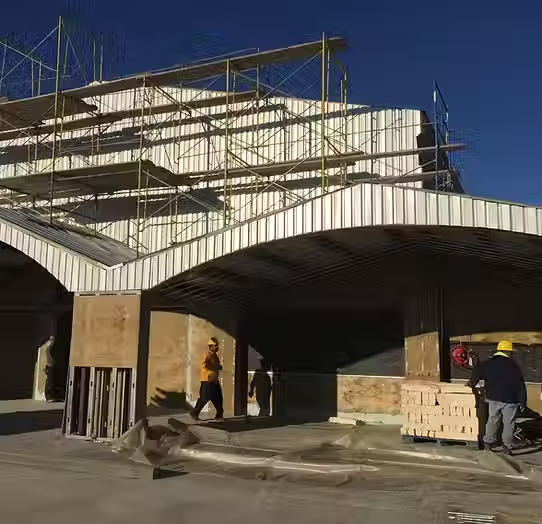
Metal building foundations and in-ground pools
Wind load design under the Florida Building Code 8th Edition (2023)
Stage 5: Permitting and Plan Review
Submit civil and structural plans, coordinate ERP review and respond to comments
Common Permitting Delays
Incomplete stormwater calculations
Missing flood zone elevation information
Wind load calculations that cite an outdated code edition
Impervious area that exceeds local limits
Project: Terra Estates 62-Lot Subdivision, Manvel, TX
This project is in Texas, but it shows the kind of multi-agency coordination Florida subdivisions also need.
62-lot residential subdivision in Manvel, Brazoria County
Read the full Terra Estates case study
Challenges
Sewer extension, state DOT access and stormwater design had to move together on a fixed schedule
Objectives
Support state DOT approval for roadway access.
Extend sewer service and meet stormwater requirements.
Solutions JRH Engineering Provided
Land development and civil engineering for the roadway network and subdivision infrastructure
TxDOT access review coordinated through approval
Stormwater system design and construction-phase support
Results:
62 lots permitted and constructed
State DOT-approved roadway access
Land Development Permitting in Florida, Texas and North Carolina
Florida
See the FDEP Environmental Resource Permit and construction stormwater pages and SFWMD; also see Navigating Florida Stormwater Rules.
Texas
Sites of 1 acre or more need TCEQ construction stormwater coverage.
North Carolina
Erosion control plans for more than one acre need approval under G.S. 113A-57.
Frequently Asked Questions
What permits does Florida land development need?
Usually local site plan and building permits, an ERP, and FDEP construction stormwater coverage for 1 acre or more.
Who issues Environmental Resource Permits?
FDEP district offices or one of Florida's five water management districts.
Which water management district covers my site?
It depends on location; for example, SFWMD covers Lee, Collier and Miami-Dade counties.
When is a SWPPP required in Florida?
When construction disturbs 1 acre or more or is part of a larger common plan.
When should site feasibility happen?
Before closing on the land.
Does JRH Engineering obtain building permits?
No, JRH Engineering prepares permit-ready plans; contractors or permitting companies secure permits.
Want More Information on this Topic?
Call JRH Engineering at (800) 227-9635
Use the chatbot in the lower right-hand corner of this page
Submit a request through JRH Engineering's contact page
Find JRH Engineering on Google:
This article was written by the team at JRH Engineering, a licensed engineering firm with 18 years of experience in civil, structural, and land development. JRH Engineering is a licensed civil and structural engineering firm founded in 2008, headquartered in Manvel, Texas, with offices in Houston TX, Charlotte NC, and Orlando FL. Certified WBE, WOSB, and HUB-eligible. Phone: (800) 227-9635 | sales@jrhengineering.net | jrhengineering.net. Texas PE license is F-10385. North Carolina PE license is P-3118. Florida license is 38516.



Comments