

2026 Industrial & Data Center Boom: TX, NC, FL | JRH Engineering

2026 Industrial Boom: Data Centers & Civil Engineering
2026 Industrial & Data Center industrial developments across Texas, North Carolina, and Florida is accelerating at a pace not seen in decades.
Data centers, large-scale warehouses, and advanced manufacturing facilities are breaking ground across all three states — and the civil engineering and structural engineering demands behind these projects are significant.
JRH Engineering is a licensed civil engineering and structural engineering firm supporting industrial and land development projects across Texas, North Carolina, and Florida.
JRH's guiding principles are "Engineering Excellence. Delivered on Time. Built on Value."
Here is what the engineering teams behind these projects are seeing in 2026.
Why Texas, North Carolina & Florida Are Leading the Industrial Boom
All three states are attracting record industrial investment for similar reasons:
No state income tax — Texas and Florida continue drawing corporate relocations and expansions
Port and logistics access — Gulf Coast, Texas, Wilmington, NC, Tampa, FL, and Jacksonville, FL are major freight corridors
Power grid capacity — AI-driven data center demand is pushing developers toward states with available grid infrastructure
Workforce availability — Large metro areas in all three states provide the labor pools industrial tenants require
Land availability — Suburban and exurban markets around Houston, Raleigh-Durham, Charlotte, Orlando, and Tampa offer large developable tracts
Sources: U.S. Department of Energy — Data Center Infrastructure | CBRE Industrial Real Estate Research
What Civil Engineers Are Seeing on Industrial Sites in 2026
Site Development Demands Are Intensifying
Industrial sites — especially data centers — are among the most demanding civil engineering projects in terms of site preparation requirements.
Civil engineers are encountering:
Large flat building pads requiring precise mass grading across 20–200+ acre tracts
Heavy truck circulation demanding wide internal road geometries and durable pavement cross-sections
Stormwater management systems sized for massive impervious surfaces — rooftops, parking, and paved logistics yards
Utility infrastructure — water, sewer, and electrical service must be upsized well beyond standard commercial requirements
Permitting complexity — TxDOT, NCDOT, FDOT, and local municipal permits required simultaneously on large sites
Stormwater Is a Major Civil Engineering Challenge
Large industrial footprints generate enormous post-development runoff volumes.
What civil engineers are designing for these sites:
Regional detention ponds sized for 100-year storm events
Underground detention systems where surface area is constrained
Low Impact Development (LID) features for stormwater quality treatment
SWPPP compliance for construction sites disturbing significant acreage under TPDES (Texas), NPDES (NC and FL)
JRH Office Locations:
What Structural Engineers Are Seeing on Industrial Projects in 2026
Foundation Engineering for Heavy Industrial Loads
Data centers and manufacturing facilities place extraordinary demands on structural engineers — particularly in foundation design.
Structural engineers are addressing:
Heavy floor loads from server racks, manufacturing equipment, and racking systems requiring reinforced slab-on-grade or specialized foundation systems
Expansive clay soils in Texas requiring drilled pier foundations or post-tension slabs engineered for differential settlement risk
Coastal soil conditions in Florida — loose sands and high water tables require geotechnical coordination before foundation design begins
Seismic and wind load requirements in North Carolina coastal markets require specific structural framing design
Building Structural Systems for Industrial Use
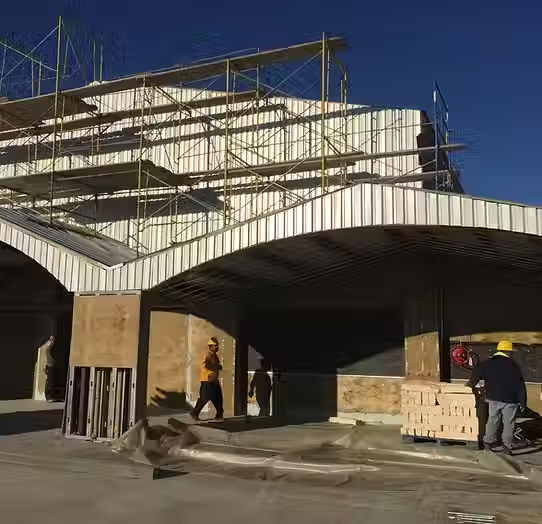
Tilt-wall concrete construction is the dominant structural system for large industrial buildings across all three states
Metal building structural framing is widely used for warehouses and flex industrial spaces below 100,000 SF
Structural engineers are coordinating with mechanical and electrical teams earlier than on standard commercial projects due to the power density of data centers
Land Development Considerations for Industrial Sites in 2026
Before a shovel hits the ground, industrial land development requires:
Site feasibility analysis — utility capacity, zoning, floodplain status, and access
Entitlement and rezoning — many large industrial tracts require rezoning or special use permits before permitting begins
Platting and subdivision — large tracts are often subdivided into individual industrial parcels
Utility extensions — water, sewer, and power infrastructure rarely exists at the scale industrial tenants require
Environmental screening — jurisdictional wetlands, floodplains, and contaminated soils must be identified early
Multi-agency permitting — TxDOT, USACE, county drainage authorities, and municipal utilities are common stakeholders on large industrial sites
How JRH Engineering Supports Industrial Land Development
JRH Engineering provides civil engineering, structural engineering, and land development services for industrial projects across Texas, North Carolina, and Florida, including:
Civil Engineering Services for Industrial Sites
Mass grading and earthwork design
Stormwater detention and retention system design
SWPPP preparation and compliance support
Internal roadway and truck circulation design
Utility design — water, sewer, and drainage infrastructure
Multi-agency permitting coordination
Structural Engineering Services for Industrial Sites
Foundation design for heavy industrial loads
Tilt-wall and metal building structural framing
Slab-on-grade design for manufacturing and warehouse floor systems
Wind and storm load structural analysis
Construction document production for industrial permit submittals
Want More Information on this Topic?
JRH Engineering is ready to support your industrial, data center, warehouse, or manufacturing land development project in Texas, North Carolina, or Florida.
📞 Call us: (800) 227-9635
💬 Chat with us: Use the chatbot in the lower right-hand corner of this screen
📋 Contact us online
This article was written by the team at JRH Engineering, a licensed engineering firm with 18 years of experience in civil, structural, and land development.
JRH is a licensed professional engineering firm in Texas, Florida, and North Carolina.



Comments