


Barndominiums vs. Custom Houses: Updated Texas Land Development 2026
Updated: Apr 30

Choosing between a barndominium and a custom-built home is one of the biggest land development decisions facing Texas property owners in 2026 — from the Houston, Dallas, Austin, and San Antonio metros to coastal markets like Galveston, Corpus Christi, and Beaumont.
JRH Engineering & Environmental Services — a woman-owned civil and structural engineering firm founded in 2008, with offices across Texas, North Carolina, and Florida — designs the foundations, structural framing, and permit-ready plans for both.
What Is a Barndominium Land Development in 2026?
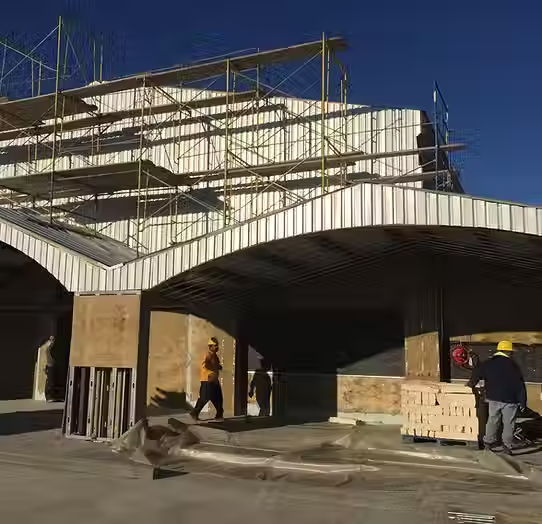
A barndominium ("barndo") is a residential structure built primarily on a pre-engineered steel frame with a metal exterior, often resembling a modern barn or shop building.
The 2026 Texas barndominium has matured well beyond rustic conversions:
Pre-engineered steel frames with clear-span interiors up to 60+ feet wide
Insulated metal panels and spray-foam roof systems for energy efficiency
Open floor plans with 14-to-18-foot ceilings
Mixed exteriors blending steel with limestone, brick, or wood accents
2026 Texas Cost Comparison
Material and labor costs stabilized after 2023 but remain elevated compared to pre-pandemic levels, according to construction cost data published by the National Association of Home Builders.
Typical 2026 turnkey ranges in Texas:
Barndominium (turnkey, 2026 Texas):
Inland metros (Dallas, Austin, San Antonio): $130–$170 per sq ft
Houston and Greater Harris County: $140–$180 per sq ft
Coastal Texas (Galveston, Corpus Christi, Beaumont): $160–$210 per sq ft
Custom Stick-Built House (turnkey, 2026 Texas):
Inland metros: $200–$280 per sq ft
Houston and Greater Harris County: $220–$320 per sq ft
Coastal Texas: $240–$360 per sq ft
A comparably finished barndominium typically comes in 20–35% below a stick-built custom home of the same size.
Build Time in Texas
Barndominium: 6–9 months from permit to move-in
Custom House: 12–18 months from permit to move-in
Pre-engineered steel components arrive partially fabricated, which cuts framing time significantly.
The American Iron and Steel Institute notes that steel framing offers consistent dimensional accuracy that streamlines field assembly across Texas's varied climate zones.
Foundations, Codes, and Permitting in Texas
Foundation Type
Barndominium: thickened-edge slab or post-tensioned slab on grade
Custom House: post-tensioned slab or pier-and-beam (regional)
Texas's expansive clay soils — particularly across the Houston, Dallas, and San Antonio metros — almost always require site-specific structural engineering regardless of which build type you choose.
Codes and Wind
The International Code Council updates the IBC, IRC, and IECC on a three-year cycle, and the 2024 editions are now widely adopted across Texas jurisdictions.
Both barndominiums and custom houses must meet:
Wind-speed requirements (especially Gulf-coast Texas)
Texas Department of Insurance windstorm engineering and WPI-8 certification in the 14 designated coastal counties
IECC energy envelope requirements
FEMA flood elevation when in a Special Flood Hazard Area
Pros and Cons at a Glance
Barndominium
Pros:
Lower cost per square foot
Faster construction schedule
Wide-open clear-span layouts
Low-maintenance metal exterior
Cons:
Fewer conventional financing options
HOA restrictions on metal siding in some Texas neighborhoods
Resale comps still maturing in some submarkets
Custom House
Pros:
Easier financing and appraisal
Broadest design and material palette
Established Texas resale comps
Cons:
Higher cost per square foot
Longer build timeline
Want More Information on this Topic?
For barndominium and custom-home foundation design, structural engineering, and permit-ready plans across Texas — and our service areas in North Carolina and Florida — contact JRH Engineering & Environmental Services:
Phone: (800) 227-9635
Use the chatbot on the lower right-hand side of the screen
Contact page: https://www.jrhengineering.net/contact-us
This article was written by the team at JRH Engineering and Environmental Services, a licensed engineering firm with 18 years of experience in civil, structural, and land development. JRH is a licensed professional engineering firm in the states of Texas, Florida, and North Carolina.



Comments