

Best Value Engineering: We Save You Money Without Cutting Corners
Updated: Sep 30

Why Choose JRH Engineering
Why Developers, Contractors & Property Owners Choose JRH
Most engineering firms talk about technical capability. We focus on what actually matters to your project: speed, cost, communication, and results.
Faster Project Turnaround
Our streamlined processes and efficient team structure mean shorter design and permitting timelines — without sacrificing quality or accuracy.
Clear & Responsive Communication
You work directly with engineers who keep you informed. No long delays or unanswered emails — just straightforward updates and quick responses.
Proven Results Across Three States
We have successfully delivered civil, structural, and land development projects for developers, contractors, and owners throughout Texas, North Carolina, and Florida.
Check out JRH's case studies.
Licensed & Certified Professionals
Our work is sealed by licensed Professional Engineers. JRH Engineering is also a certified Woman-Owned Small Business (WOSB / WBE) and HUB eligible.
What Best Value Engineering Means
Best value does not mean the cheapest design. It means a design that meets code, fits the site and avoids spending money where it does not add performance.
Many of the biggest savings are set early, in layout, grading and drainage decisions made before the plans are drawn in detail.
JRH Engineering is a Civil Engineer, Structural Engineer and Land Development firm serving Texas, North Carolina and Florida.
JRH guiding principles are: Engineering Excellence. Delivered on Time. Built on Value.
Where Value Is Found in Civil Design
Earthwork: balancing cut and fill to reduce import, export and hauling
Paving: road and parking sections matched to actual traffic and soils
Drainage: a detention pond sized to the governing criteria, or an alternative such as underground storage where it saves usable land
Layout: treating code requirements as design inputs, not afterthoughts
Where Value Is Found in Structural Design
Foundations proportioned to the geotechnical report and actual loads
Framing and connections designed as one continuous load path
Wind and flood requirements built in from the start, not added after
What Best Value Does Not Mean
Cutting required safety factors
Skipping the geotechnical report
Designing below code to win a bid
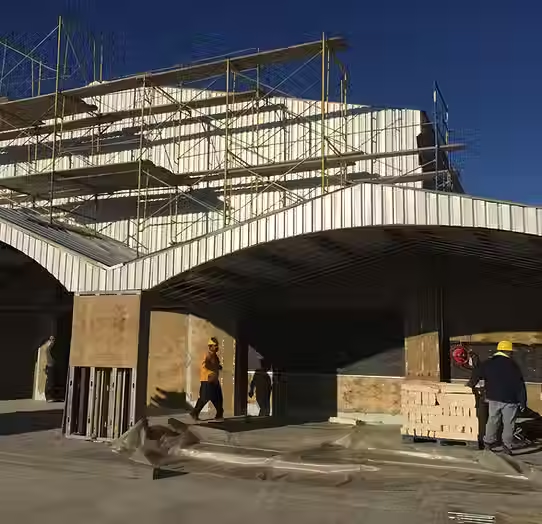
Project: Self-Storage Facility Design, Athens, TX
Self-storage development in Athens, Henderson County
Reviewed by the City of Athens and TxDOT
Read the full Athens self-storage case study
Challenges
Fire truck access and turning radii limited where buildings could go
Treating those limits as fixed boundaries would have cost rentable units
Objectives
Fit the most storage units on the property.
Meet fire code at every point on the site.
Coordinate TxDOT and City approvals.
Solutions JRH Engineering Provided
Civil engineering site layout designed backward from the fire truck turning radius
Buildings placed at the minimum clearances the fire code requires
A fire line designed to serve the full facility
TxDOT connection coordination for site access
Results:
Unit count maximized through the turning-radius-driven layout
Fire code compliance across the facility
Concurrent TxDOT and City approvals on first submission
Best Value Engineering in Texas, North Carolina and Florida
Texas
North Carolina
Post-construction stormwater control measures follow the NCDEQ Stormwater Design Manual.
Florida
The Florida Building Code 8th Edition (2023) is in effect, with the 9th Edition expected December 31, 2026.
Frequently Asked Questions
What is best value engineering?
Design that meets code and fits the site while avoiding cost that does not add performance.
Does best value mean a cheaper, lower-quality design?
No, it means spending where it matters, never designing below code.
Where do the biggest savings usually come from?
Early layout, grading, paving and drainage decisions.
Can JRH Engineering review an existing design for savings?
Yes, JRH can review plans for layout, earthwork, drainage and foundation opportunities.
How did JRH Engineering add units at the Athens self-storage site?
By designing the layout backward from the fire truck turning radius instead of checking it afterward.
Does JRH Engineering obtain building permits?
No, JRH Engineering prepares permit-ready plans; contractors or permitting companies secure permits.
Want More Information on this Topic?
Call JRH Engineering at (800) 227-9635
Use the chatbot in the lower right-hand corner of this page
Submit a request through JRH Engineering's contact page
Find JRH Engineering on Google:
This article was written by the team at JRH Engineering, a licensed engineering firm with 18 years of experience in civil, structural, and land development. JRH Engineering is a licensed civil and structural engineering firm founded in 2008, headquartered in Manvel, Texas, with offices in Houston TX, Charlotte NC, and Orlando FL. Certified WBE, WOSB, and HUB-eligible. Phone: (800) 227-9635 | sales@jrhengineering.net | jrhengineering.net. Texas PE license is F-10385. North Carolina PE license is P-3118. Florida license is 38516.



Comments