


Out-of-State Guide to Texas Land Development 2026 | JRH Engineering
Updated: 2 days ago

Why Choose JRH Engineering
Why Developers, Contractors & Property Owners Choose JRH
Most engineering firms talk about technical capability. We focus on what actually matters to your project: speed, cost, communication, and results.
Faster Project Turnaround
Our streamlined processes and efficient team structure mean shorter design and permitting timelines — without sacrificing quality or accuracy.
Clear & Responsive Communication
You work directly with engineers who keep you informed. No long delays or unanswered emails — just straightforward updates and quick responses.
Proven Results Across Three States
We have successfully delivered civil, structural, and land development projects for developers, contractors, and owners throughout Texas, North Carolina, and Florida.
Check out JRH's case studies.
Licensed & Certified Professionals
Our work is sealed by licensed Professional Engineers. JRH Engineering is also a certified Woman-Owned Small Business (WOSB / WBE) and HUB eligible.
Building in Texas From Out of State
Developers come to Texas from across the country. According to U.S. Census QuickFacts, the state had 31,709,821 residents in July 2025, up 8.8% since April 2020. Texas also has no state personal income tax.
Out-of-state owners often lose time by assuming the rules they know from home apply here.
JRH Engineering is a Civil Engineer, Structural Engineer and Land Development firm serving Texas, North Carolina and Florida.
JRH guiding principles are: Engineering Excellence. Delivered on Time. Built on Value.
Rules That Surprise Out-of-State Developers
City vs. county review: a site can sit inside city limits, in a city's extraterritorial jurisdiction (the area just outside city limits) or in an unincorporated county, and each can mean different reviewers and standards
Drainage districts: many Texas sites answer to a drainage or flood control district in addition to the city or county
Houston detention pond rules: the City of Houston's IDMS-2025-01 supplement requires 0.8 acre-feet of storage per acre of proposed impervious area for many non-single-family tracts of 20 acres or less
TxDOT access and drainage: TxDOT Houston District guidelines state its drainage systems are not intended to serve new development
Construction stormwater: sites disturbing 1 acre or more need TCEQ Construction General Permit coverage and a stormwater pollution prevention plan (SWP3) before construction
Coastal windstorm: in Texas's designated catastrophe area, TDI windstorm rules apply, with the 2024 IRC and IBC effective April 1, 2026
Sealed plans: engineering plans for Texas projects must be sealed by a Texas-licensed professional engineer
A 5-Step Checklist
Order a feasibility review before closing.
Identify every reviewing agency: city, county, drainage district and TxDOT.
Confirm the local detention pond and floodplain criteria.
Get soils data (by others) before foundation design.
Budget time for review comments and resubmittals.
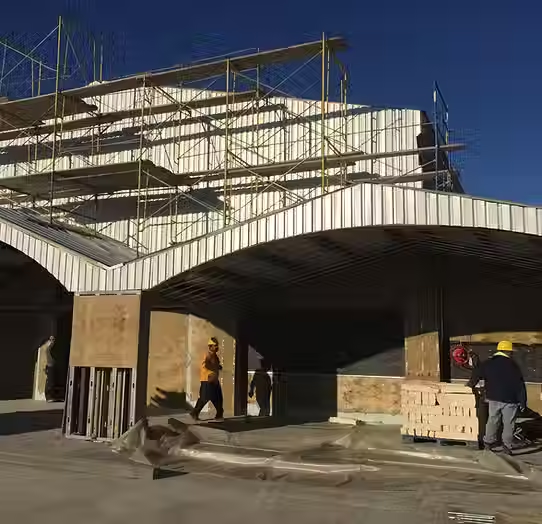
Project: Castle Road Self-Storage Complex, Waller, TX
Multi-building self-storage complex in Waller, Harris County
Drainage approval through Harris County
Read the full Castle Road case study
Challenges
An existing drainage channel ran through the middle of the site
A traditional gravity detention pond would have taken rentable land
Objectives
Clear the interior of the site for storage buildings.
Shrink the detention pond footprint.
Solutions JRH Engineering Provided
Full site civil engineering: building layout, grading, paving and access
Rerouted the drainage channel to the property perimeter
Designed a pumped detention pond system in place of gravity detention pond storage
Results:
Interior site fully cleared for storage buildings
Smaller detention pond footprint and more rentable square footage
Texas Compared With North Carolina and Florida
Texas
North Carolina
Erosion control plans for more than one acre need approval under G.S. 113A-57.
Florida
Most sites need an FDEP or water management district Environmental Resource Permit.
Frequently Asked Questions
Why do out-of-state developers choose Texas?
Population growth, no state personal income tax and strong metro demand.
Do Texas projects need a Texas-licensed engineer?
Yes, engineering plans must be sealed by a Texas-licensed professional engineer.
Who reviews a Texas site development?
Often a city or county, a drainage district and sometimes TxDOT.
How much detention pond storage does Houston require?
0.8 acre-feet per acre of proposed impervious area for many non-single-family tracts of 20 acres or less.
When is a TCEQ stormwater permit required?
When construction disturbs 1 acre or more.
Does JRH Engineering obtain building permits?
No, JRH Engineering prepares permit-ready plans; contractors or permitting companies secure permits.
Want More Information on this Topic?
Call JRH Engineering at (800) 227-9635
Use the chatbot in the lower right-hand corner of this page
Submit a request through JRH Engineering's contact page
Find JRH Engineering on Google:
This article was written by the team at JRH Engineering, a licensed engineering firm with 18 years of experience in civil, structural, and land development. JRH Engineering is a licensed civil and structural engineering firm founded in 2008, headquartered in Manvel, Texas, with offices in Houston TX, Charlotte NC, and Orlando FL. Certified WBE, WOSB, and HUB-eligible. Phone: (800) 227-9635 | sales@jrhengineering.net | jrhengineering.net. Texas PE license is F-10385. North Carolina PE license is P-3118. Florida license is 38516.



Comments