


500-Year Floodplain Building Requirements in Houston
Updated: 24 hours ago

Building in Houston's 500-year floodplain comes with a specific set of engineering, permitting, and design requirements.
Property owners, developers, and contractors who understand these rules early tend to avoid costly redesigns, permit delays, and change orders later in the project.
JRH Engineering has guided civil, structural, and land development projects through floodplain permitting across Harris County and the greater Houston area for 18 years.
JRH guiding principles are: Engineering Excellence. Delivered on Time. Built on Value.
This guide breaks down what the 500-year floodplain designation means, what Houston and Harris County generally require, and how a project team can plan around it.
Why Choose JRH Engineering
Why Developers, Contractors & Property Owners Choose JRH Engineering
Most engineering firms talk about technical capability.
We focus on what actually matters to your project: speed, cost, communication, and results.
Faster Project Turnaround
Our streamlined processes and efficient team structure mean shorter design and permitting timelines.
This happens without sacrificing quality or accuracy.
Lower Overall Project Cost
A low-overhead business model allows us to deliver competitive engineering fees while maintaining high standards.
JRH Engineering does not carry the large overhead expenses that many large engineering firms carry.
You get professional results without unnecessary costs.
Clear & Responsive Communication
You work directly with engineers who keep you informed.
No long delays or unanswered emails — just straightforward updates and quick responses.
Proven Results Across Three States
We have delivered civil, structural, and land development projects for developers, contractors, and owners throughout Texas, North Carolina, and Florida.
Check out JRH Engineering's case studies to see similar projects.
Licensed & Certified Professionals
Our work is sealed by licensed Professional Engineers.
JRH Engineering is also a certified Woman-Owned Small Business (WOSB / WBE) and HUB eligible, creating additional opportunities for public and private projects.
1. Project
Location: Southbelt area, Houston, Harris County, Texas
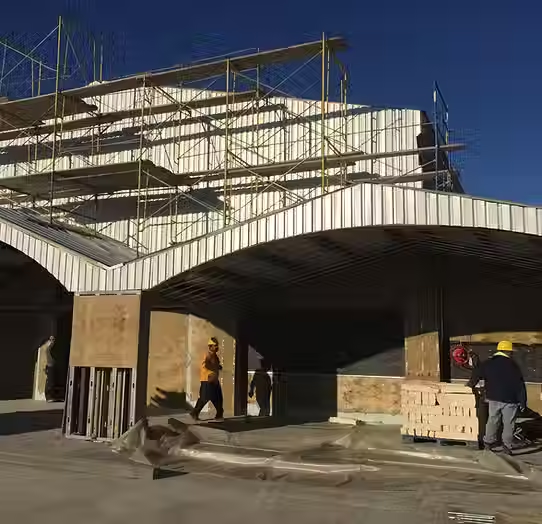
Project Type: Manufacturing warehouse expansion located within the 500-year floodplain.
A manufacturing operator in the Southbelt area of Houston needed to expand an existing warehouse building on a site situated inside the 500-year floodplain.
The expansion had already been partially built before floodplain compliance was addressed, which added complexity to the permitting path.
This is a common scenario in Harris County, where rapid site development sometimes outpaces the floodplain review process.
2. Challenges
Projects located in Houston's 500-year floodplain generally face several recurring challenges:
Determining the correct Base Flood Elevation (BFE) for the site
Retroactively bringing an already-constructed expansion into compliance
Coordinating with Harris County floodplain management staff on required documentation
Avoiding delays to occupancy or continued operations during the review
Managing the cost impact of redesign work discovered late in construction
For the Southbelt warehouse project specifically, the building had already been expanded without the floodplain permitting fully resolved, which raised the stakes for a fast, defensible engineering solution.
3. Objectives
The engineering objectives for a project like this typically include:
Confirm the applicable Base Flood Elevation and flood zone designation for the parcel
Document existing conditions accurately for submission to Harris County
Bring the structure and site into compliance with local floodplain regulations
Minimize disruption to an operating facility
Reduce the risk of future flood damage, insurance complications, or code enforcement issues
4. Solutions JRH Engineering Provided
JRH Engineering worked through retroactive floodplain permitting for the Southbelt warehouse expansion, which generally involves:
Site and elevation survey review to confirm the property's flood zone and BFE relative to the existing structure
Engineering documentation prepared to support the floodplain development permit application
Coordination with Harris County floodplain management reviewers to resolve the compliance gap
Structural and civil engineering review of the expansion to confirm the design met applicable elevation and construction standards
Permit resolution support to help the property continue operating while the compliance record was corrected
You can review the full details on the Retroactive Floodplain Permitting, Houston TX case study page.
Understanding the 500-Year Floodplain
What Is the 500-Year Floodplain?
The 500-year floodplain is the area with roughly a 0.2% chance of flooding in any given year.
It does not mean a flood happens only once every 500 years.
It signifies a lower-probability, but still real, risk of a severe flood event.
500-Year vs. 100-Year Floodplain
The 100-year floodplain (also called the Special Flood Hazard Area) has about a 1% annual chance of flooding.
The 500-year floodplain sits outside that zone but can still carry elevation, insurance, and permitting considerations depending on the jurisdiction and project type.
According to FEMA, the Base Flood Elevation is generally tied to the 1% annual chance (100-year) flood, and many communities layer additional requirements for structures near or within the broader 500-year zone.
Common Building Requirements in Houston's Floodplain
Elevation Requirements
Structures are generally required to be elevated above the Base Flood Elevation (BFE), which represents the predicted water level during a flood event.
Elevating a structure above this level can meaningfully reduce flood damage risk.
Foundation Standards
Foundations within a floodplain generally need to meet specific engineering standards for stability during flood events.
Flood-resistant materials can further help protect a foundation from water damage and erosion.
Utilities and Mechanical Systems
Utilities and mechanical components are generally positioned above the BFE, or otherwise protected, to help keep systems operational during a flood event.
Flood Vents
In areas below the BFE, flood vents are often required.
These allow water to flow in and out, which reduces hydrostatic pressure on the structure during flooding.
Permits and Inspections
Compliance in Houston's floodplain generally requires permits from Harris County or the applicable local authority.
Inspections during and after construction help confirm the work meets applicable building codes.
The Harris County Engineering Department's floodplain management page outlines local permitting resources for property owners.
Letters of Map Amendment (LOMA)
In some cases, a property owner may be able to request that FEMA formally remove a structure from a Special Flood Hazard Area through a Letter of Map Amendment or Letter of Map Revision-Based on Fill.
This process generally requires a licensed surveyor or Professional Engineer to prepare supporting elevation documentation.
How a Civil Engineer or Structural Engineer Can Help
A qualified civil engineer typically evaluates drainage, site grading, and detention requirements tied to floodplain compliance.
A structural engineer typically evaluates the foundation, elevation, and flood-resistant construction details for the building itself.
For projects that include site development or subdivision work, land development engineering may also be involved to confirm the overall site plan accounts for floodplain constraints from the start.
JRH Engineering's civil engineering and land development team works on these project types across Texas, North Carolina, and Florida.
FAQ: Houston 500-Year Floodplain Building Requirements
What is the 500-year floodplain?
It is the area with roughly a 0.2% chance of flooding in a given year, indicating a lower-probability but still meaningful flood risk.
Is the 500-year floodplain the same as the 100-year floodplain?
No.
The 100-year floodplain (Special Flood Hazard Area) has roughly a 1% annual chance of flooding, while the 500-year floodplain reflects a lower annual probability.
What is Base Flood Elevation (BFE)?
BFE is the predicted water surface elevation during a flood event, generally tied to the 1% annual chance flood, and it is used to help set minimum elevation requirements for structures.
Do I need a permit to build in Houston's floodplain?
In most cases, yes.
Harris County and the City of Houston generally require a floodplain development permit before construction begins on a property within a mapped floodplain.
What happens if a building was constructed without floodplain approval?
A retroactive floodplain permit may be needed, which generally involves an elevation survey, engineering documentation, and coordination with the local floodplain management office.
Are flood vents required for all buildings in the floodplain?
Flood vents are commonly required for enclosed areas below the Base Flood Elevation, though specific requirements can vary by structure type and local code.
Can a structural engineer help reduce flood risk for an existing building?
Yes.
A structural engineer can evaluate elevation options, foundation modifications, and flood-resistant construction details for existing buildings in a floodplain.
Does JRH Engineering work on floodplain projects outside of Houston?
Yes.
JRH Engineering provides civil engineering, structural engineering, and land development services for floodplain-related projects throughout Texas, North Carolina, and Florida.
Want More Information on this Topic?
If you have a property or project located in Houston's floodplain, the JRH Engineering team can help you understand what applies to your site.
You can reach JRH Engineering a few different ways:
Call: (800) 227-9635
Chat: Use the chatbot in the lower right-hand corner of this screen
Contact Form: Visit the JRH Engineering contact page
JRH Engineering also maintains local Google Business Profiles for the Houston area, including the Houston, Texas profile and the Manvel, Texas profile.
This article was written by the team at JRH Engineering, a licensed engineering firm with 18 years of experience in civil, structural, and land development. JRH Engineering is a licensed civil and structural engineering firm founded in 2008, headquartered at 6520 Masters, Manvel, Texas 77578, with offices in Houston TX, Charlotte NC, and Orlando FL. Certified WBE, WOSB, and HUB-eligible. Phone: (800) 227-9635 | sales@jrhengineering.net | jrhengineering.net. Texas PE license is F-10385. North Carolina PE license is P-3118. Florida license is 38516.



Comments