


Engineering for Texas and North Carolina's Fastest-Growing Cities
Updated: Oct 14

Why Choose JRH Engineering
Why Developers, Contractors & Property Owners Choose JRH
Most engineering firms talk about technical capability.
We focus on what actually matters to your project: speed, cost, communication, and results.
Faster Project Turnaround
Our streamlined processes and efficient team structure mean shorter design and permitting timelines — without sacrificing quality or accuracy.
Clear & Responsive Communication
You work directly with engineers who keep you informed.
No long delays or unanswered emails — just straightforward updates and quick responses.
Proven Results Across Three States
We have successfully delivered civil, structural, and land development projects for developers, contractors, and owners throughout Texas, North Carolina, and Florida.
Check out JRH’s case studies.
Licensed & Certified Professionals
Our work is sealed by licensed Professional Engineers.
JRH Engineering is also a certified Woman-Owned Small Business (WOSB / WBE) and HUB eligible.
Growth Brings Engineering Challenges
Houston, Austin, Charlotte and Raleigh metros keep adding residents and businesses.
Texas alone reached an estimated 31,709,821 people in July 2025, according to the U.S. Census Bureau.
Growth like that drives up land prices, puts pressure on roads and utilities, and makes every buildable acre count.
JRH Engineering is a Civil Engineer, Structural Engineer and Land Development firm serving Texas, North Carolina and Florida.
JRH guiding principles are: Engineering Excellence. Delivered on Time. Built on Value.
Common Challenges in Fast-Growing Cities
Higher land costs: owners need more usable area from every site
Tight and infill sites: less room for parking, detention pond storage and access
Utility capacity: water and sewer extensions or upgrades may be needed
Traffic and access: driveways and turn lanes reviewed by cities and state transportation agencies
Zoning: setbacks, density and use limits shape what can be built
Civil and Land Development Solutions
Site layouts that balance building area, parking and drive aisles
Detention pond storage designed into the site plan early, or underground where land is tight
Retaining walls up to 6 feet to manage grade changes
Utility extensions sized for the development
Zoning and feasibility review before purchase
Structural Solutions
Foundations and framing for new multi-story residential and commercial buildings
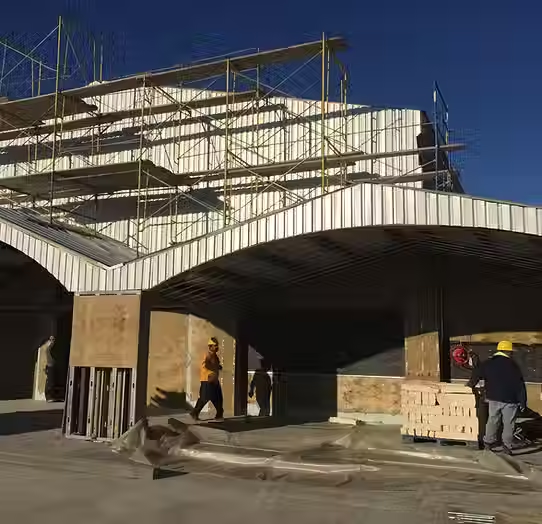
Pre-engineered metal building foundations up to 120,000 square feet
Structural design for new additions
State Rules to Know
Texas: sites disturbing 1 acre or more need TCEQ construction stormwater coverage.
In the City of Houston, Supplement IDMS-2025-01 requires 0.8 acre-feet of detention pond storage per acre for non-single-family tracts of 20 acres or less.
North Carolina: erosion control plans for more than 1 acre need approval under G.S. 113A-57.
Project: Cane Island Pkwy. Office Condo Park, Katy, TX
16.1-acre office condo park in Katy, a fast-growing Houston suburb
Read the full Cane Island case study
Challenges
Designing detention pond infrastructure from scratch would have added a design cycle
A significant grade change on one side could have required extensive regrading
Objectives
Accelerate permitting.
Preserve the full site for development.
Solutions JRH Engineering Provided
Land development and civil site design: grading, paving and public road access
Previously approved detention pond plans from a comparable Katy project reused
A targeted retaining wall on the grade-change side
Results:
Permitting accelerated through a familiar detention pond approach
The full 16.1 acres preserved for development
Growth Resources for Texas, North Carolina and Florida
Texas
North Carolina
Florida
See FDEP’s Environmental Resource Permit program.
Frequently Asked Questions
What slows development in fast-growing cities?
Tight sites, utility capacity, access reviews and zoning limits.
How can a tight site meet detention pond requirements?
With storage planned early in the layout, or underground storage where land is limited.
How much detention pond storage does Houston require?
0.8 acre-feet per acre for non-single-family tracts of 20 acres or less.
Does JRH design renovations or retrofits?
No, JRH designs new construction and new additions.
Does JRH perform environmental site assessments?
No, environmental studies are by others.
Does JRH Engineering obtain building permits?
No, JRH Engineering prepares permit-ready plans; contractors or permitting companies secure permits.
Want More Information on this Topic?
Call JRH Engineering at (800) 227-9635
Use the chatbot in the lower right-hand corner of this page
Submit a request through JRH Engineering’s contact page
Find JRH Engineering on Google:
This article was written by the team at JRH Engineering, a licensed engineering firm with 18 years of experience in civil, structural, and land development. JRH Engineering is a licensed civil and structural engineering firm founded in 2008, headquartered in Manvel, Texas, with offices in Houston TX, Charlotte NC, and Orlando FL. Certified WBE, WOSB, and HUB-eligible. Phone: (800) 227-9635 | sales@jrhengineering.net | jrhengineering.net. Texas PE license is F-10385. North Carolina PE license is P-3118. Florida license is 38516.



Comments