


The Hidden Price Tag: How Development Codes & Restrictive Zoning Inflate Project Costs Before Ground is Broken
Updated: Oct 2

Why Choose JRH Engineering
Why Developers, Contractors & Property Owners Choose JRH
Most engineering firms talk about technical capability. We focus on what actually matters to your project: speed, cost, communication, and results.
Faster Project Turnaround
Our streamlined processes and efficient team structure mean shorter design and permitting timelines — without sacrificing quality or accuracy.
Clear & Responsive Communication
You work directly with engineers who keep you informed. No long delays or unanswered emails — just straightforward updates and quick responses.
Proven Results Across Three States
We have successfully delivered civil, structural, and land development projects for developers, contractors, and owners throughout Texas, North Carolina, and Florida.
Check out JRH's case studies.
Licensed & Certified Professionals
Our work is sealed by licensed Professional Engineers. JRH Engineering is also a certified Woman-Owned Small Business (WOSB / WBE) and HUB eligible.
The First Cost of Development Is the Rules
Before any dirt moves, development codes, zoning and impact fees can decide whether a project works.
Many of these costs show up only when a civil engineer tests the site against the rules that apply to it.
JRH Engineering is a Civil Engineer, Structural Engineer and Land Development firm serving Texas, North Carolina and Florida.
JRH guiding principles are: Engineering Excellence. Delivered on Time. Built on Value.
Shallow Outfalls and the Detention Pond Footprint
When the storm sewer or ditch that receives site runoff is shallow, a gravity detention pond has to spread out to get enough storage
On tight sites, that pond can take a large share of the usable land
When Pumped Systems Are Not Allowed
Some jurisdictions restrict pumped detention pond systems
The alternative can be importing fill and raising pads, parking and drives so a gravity system works
Impact Fees
Roadway, water and wastewater impact fees are set locally and can change a pro forma
Roadway fees are often tied to trip generation, so land use and building size matter
Zoning and Approval Uncertainty
Rezoning, variances and long reviews add carrying cost even when no one says no
Where there is no zoning, as in Houston, deed restrictions and ordinance codes still apply
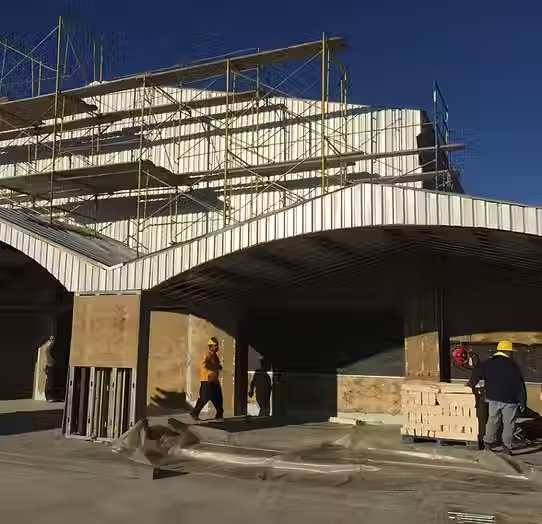
Project: Jordan Ranch Blvd. Office Condos, Brookshire, TX
18.20-acre office condo development in Brookshire, Waller County
Reviewed by TxDOT, the Brazos-Katy Drainage District, the City of Brookshire and a MUD
Read the full Jordan Ranch case study
Challenges
Every acre of detention pond was an acre that could not generate lease revenue
A TxDOT-compliant turn lane was needed on the adjacent corridor
Objectives
Maximize leasable building area.
Secure TxDOT turn lane approval.
Solutions JRH Engineering Provided
Civil engineering site design: grading, paving, parking and building pads
An on-site detention pond with a lift station instead of a traditional gravity pond, reducing the footprint
TxDOT driveway and access permit plans
Simultaneous submittals to TxDOT, the drainage district and the City
Results:
Leasable area protected through a compact detention pond
TxDOT turn lane permit obtained alongside drainage and City approvals
Development Costs in Texas, North Carolina and Florida
Texas
The City of Houston Planning Department says Houston does not have zoning but is governed by ordinance codes; see Does City of Houston Have Zoning? and Not All Dirt Is Worth the Dig.
North Carolina
Local development regulation is governed by G.S. Chapter 160D.
Florida
Stormwater permitting runs through the Environmental Resource Permit program (FDEP ERP).
Frequently Asked Questions
How can development codes raise costs before construction?
Detention pond rules, fill requirements, impact fees and approval timelines can add cost before any building starts.
Why does a shallow outfall matter?
It limits how deep a gravity detention pond can be, so the pond needs more land.
What if a pumped detention pond is not allowed?
The site may need imported fill and raised pads so a gravity system works.
What are impact fees?
Local fees for roadway, water and wastewater capacity, often tied to land use and size.
How did JRH Engineering protect leasable area at Jordan Ranch?
With a lift station detention pond system instead of a traditional gravity pond.
Does JRH Engineering obtain building permits?
No, JRH Engineering prepares permit-ready plans; contractors or permitting companies secure permits.
Want More Information on this Topic?
Call JRH Engineering at (800) 227-9635
Use the chatbot in the lower right-hand corner of this page
Submit a request through JRH Engineering's contact page
Find JRH Engineering on Google:
This article was written by the team at JRH Engineering, a licensed engineering firm with 18 years of experience in civil, structural, and land development. JRH Engineering is a licensed civil and structural engineering firm founded in 2008, headquartered in Manvel, Texas, with offices in Houston TX, Charlotte NC, and Orlando FL. Certified WBE, WOSB, and HUB-eligible. Phone: (800) 227-9635 | sales@jrhengineering.net | jrhengineering.net. Texas PE license is F-10385. North Carolina PE license is P-3118. Florida license is 38516.



Comments