


JRH Engineering Structural Services for Owners & Developers in TX, NC, & FL
Updated: Oct 12

Why Choose JRH Engineering
Why Developers, Contractors & Property Owners Choose JRH
Most engineering firms talk about technical capability.
We focus on what actually matters to your project: speed, cost, communication, and results.
Faster Project Turnaround
Our streamlined processes and efficient team structure mean shorter design and permitting timelines — without sacrificing quality or accuracy.
Clear & Responsive Communication
You work directly with engineers who keep you informed. No long delays or unanswered emails — just straightforward updates and quick responses.
Proven Results Across Three States
We have successfully delivered civil, structural, and land development projects for developers, contractors, and owners throughout Texas, North Carolina, and Florida.
Check out JRH’s case studies.
Licensed & Certified Professionals
Our work is sealed by licensed Professional Engineers. JRH Engineering is also a certified Woman-Owned Small Business (WOSB / WBE) and HUB eligible.
Why Owners and Developers Need a Structural Engineer
Texas, North Carolina and Florida keep adding homes, warehouses and commercial buildings.
Each one needs a structure designed for its loads, its soils and its local wind and flood conditions, and sealed plans the building department will accept.
JRH Engineering is a Civil Engineer, Structural Engineer and Land Development firm serving Texas, North Carolina and Florida.
JRH guiding principles are: Engineering Excellence. Delivered on Time. Built on Value.
What Structural Engineering Protects
Safety: a complete load path from roof to foundation for gravity, wind and flood loads
Code compliance: designs to the edition each jurisdiction enforces
Budget: right-sized members and foundations that avoid overbuilding and late redesigns
Structural Services for New Construction
Foundations: slab-on-grade, post-tensioned slabs, pier and beam, drilled piers and helical piles, designed from a geotechnical report (by others)
Framing: wood, steel and masonry for homes, multifamily and commercial buildings
Metal buildings: foundations for pre-engineered metal buildings and barndominiums
New additions: structural design for additions to existing homes (not remodels)
Site structures: in-ground pools up to 5.5 feet deep and retaining walls up to 6 feet
Windstorm: WPI-8 support in Brazoria and Galveston counties
Code Status by State
Texas: in TDI’s coastal catastrophe area, the 2024 IRC and IBC took effect for windstorm certification on April 1, 2026
North Carolina: the NC Office of State Fire Marshal lists the 2018 codes as current, with the 2024 edition approved but not yet in effect
Florida: the Florida Building Code 8th Edition (2023) applies until the 9th Edition takes effect
Growth Driving Demand
The Census Bureau estimated Texas’s population at 31,709,821 in July 2025.
Growth like that keeps structural engineers busy with new subdivisions, warehouses and commercial buildings across all three states.
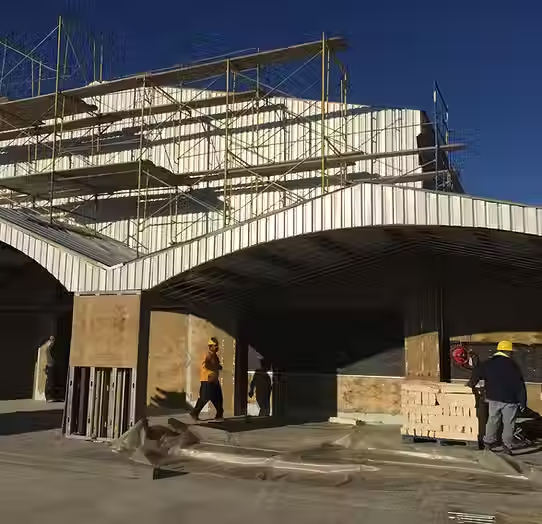
Project: Southwest Shipyards Barge Construction Building, Galveston, TX
Heavy-industrial building on Pelican Island, Galveston, used to build and launch barges
Read the full Southwest Shipyards case study
Challenges
Foundations had to support four 60-ton overhead cranes at once
Soft coastal soils could not carry those loads near the surface
Objectives
Design foundations for heavy crane loads on coastal soils.
Enable direct side-launch of completed barges.
Solutions JRH Engineering Provided
Structural engineering foundation design and civil site design
Auger cast piers approximately 130 feet deep to reach stable bearing soils
Pile caps engineered for simultaneous loading from all four cranes
Results:
Heavy crane loads supported on coastal soils
City of Galveston and Corps of Engineers approvals secured
Structural Resources for Texas, North Carolina and Florida
Texas
See TDI windstorm and Types of Foundation.
North Carolina
Florida
See the Florida Building Code.
Frequently Asked Questions
When do I need a structural engineer?
For new buildings, new additions, foundations and other work the building official requires to be sealed.
What types of foundations does JRH design?
Slab-on-grade, post-tensioned slabs, pier and beam, drilled piers and helical piles.
Does JRH design remodels or retrofits?
No, JRH designs new construction and new additions, not remodels.
Does JRH provide windstorm certification support?
Yes, WPI-8 support in Brazoria and Galveston counties.
Does JRH design pools?
Yes, in-ground pools up to 5.5 feet deep.
Does JRH Engineering obtain building permits?
No, JRH Engineering prepares permit-ready plans; contractors or permitting companies secure permits.
Want More Information on this Topic?
Call JRH Engineering at (800) 227-9635
Use the chatbot in the lower right-hand corner of this page
Submit a request through JRH Engineering’s contact page
Find JRH Engineering on Google:
This article was written by the team at JRH Engineering, a licensed engineering firm with 18 years of experience in civil, structural, and land development. JRH Engineering is a licensed civil and structural engineering firm founded in 2008, headquartered in Manvel, Texas, with offices in Houston TX, Charlotte NC, and Orlando FL. Certified WBE, WOSB, and HUB-eligible. Phone: (800) 227-9635 | sales@jrhengineering.net | jrhengineering.net. Texas PE license is F-10385. North Carolina PE license is P-3118. Florida license is 38516.



Comments