


Private Aircraft Hangar Layouts for Florida’s Hurricane-Prone Region
Updated: 7 days ago

Why Choose JRH Engineering
Why Developers, Contractors & Property Owners Choose JRH
Most engineering firms talk about technical capability. We focus on what actually matters to your project: speed, cost, communication, and results.
Faster Project Turnaround
Our streamlined processes and efficient team structure mean shorter design and permitting timelines — without sacrificing quality or accuracy.
Clear & Responsive Communication
You work directly with engineers who keep you informed. No long delays or unanswered emails — just straightforward updates and quick responses.
Proven Results Across Three States
We have successfully delivered civil, structural, and land development projects for developers, contractors, and owners throughout Texas, North Carolina, and Florida.
Check out JRH's case studies.
Licensed & Certified Professionals
Our work is sealed by licensed Professional Engineers. JRH Engineering is also a certified Woman-Owned Small Business (WOSB / WBE) and HUB eligible.
Planning a Private Hangar Layout in Florida
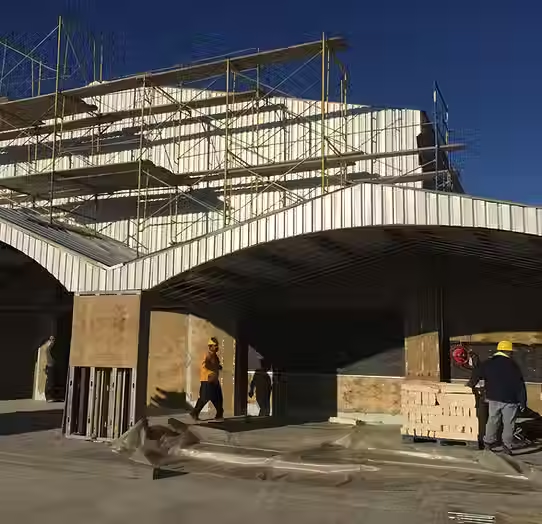
A private hangar in Florida has to fit the aircraft, the door and the site while standing up to hurricane wind and heavy rain.
Layout decisions, from door size to where equipment sits, drive the structural, foundation and site design.
JRH Engineering is a Structural Engineer, Civil Engineer and Land Development firm serving Texas, North Carolina and Florida.
JRH guiding principles are: Engineering Excellence. Delivered on Time. Built on Value.
Layout Decisions That Affect Hurricane Performance
Door size and type: the largest opening in the building controls much of the frame and foundation design
Door location: orientation to the taxiway, apron and prevailing wind affects loads and access
Clear span: column-free floor space for aircraft movement needs a stronger primary frame
Equipment and electrical: placement relative to the site's flood elevation
Personnel doors and exits: set by the building code and the local fire marshal
Structural and Site Items to Coordinate
Wind-rated hangar doors, roofing and cladding with Florida product approval
Foundations and anchorage sized for door and frame reactions
Grading that moves water away from the floor and apron, with a detention pond or other stormwater system where required
Fire protection under NFPA 409 where it applies
Project: CMU Masonry Custom Home Structural Design, Arcadia, FL
This Florida project is not a hangar, but it shows the same high-wind structural detailing a hangar needs.
Single-family CMU custom home in Arcadia, DeSoto County
Permitting through DeSoto County under the Florida Building Code 8th Edition (2023)
Read the full Arcadia case study
Challenges
A 148 mph basic wind speed with Exposure D
Every opening needed a properly sized lintel
Foundation dowels had to align with the masonry cores
Objectives
Engineer the masonry system for the design wind loads.
Detail openings and dowels for the contractor.
Solutions JRH Engineering Provided
Structural engineering design to ASCE 7-22 and ACI 530.1
Precast concrete lintels sized for every opening
Foundation dowels coordinated with vertical masonry cores
Special inspection requirements shown on the plans
Results:
PE-sealed plans for DeSoto County permitting
Masonry structure engineered for 148 mph wind
Lintels specified over every opening
Hangar Design in Florida, Texas and North Carolina
Florida
The Florida Building Code 8th Edition (2023) is in effect, with the 9th Edition expected December 31, 2026.
Miami-Dade and Broward counties are in the High-Velocity Hurricane Zone (HVHZ), with stricter product approval rules.
Texas
See 2026 Private Aircraft Hangar Design Updates for a Texas airpark example.
North Carolina
The NC Office of State Fire Marshal lists the 2018 NC codes as current, with 2024 pending; see NFPA 409 Compliance.
Frequently Asked Questions
What layout choice most affects hangar wind design?
The size and location of the main door, since it is the largest opening in the building.
Do Florida hangar doors need product approval?
Yes, doors, roofing and cladding need Florida product approval, with stricter rules in the HVHZ.
Which Florida counties are in the HVHZ?
Miami-Dade and Broward counties.
Where should hangar equipment and electrical go?
Above the site's required flood elevation, as set by the local floodplain rules.
Does NFPA 409 apply to private hangars?
It may, depending on the hangar and what the local jurisdiction has adopted.
Does JRH Engineering obtain building permits?
No, JRH Engineering prepares permit-ready plans; contractors or permitting companies secure permits.
Want More Information on this Topic?
Call JRH Engineering at (800) 227-9635
Use the chatbot in the lower right-hand corner of this page
Submit a request through JRH Engineering's contact page
Find JRH Engineering on Google:
This article was written by the team at JRH Engineering, a licensed engineering firm with 18 years of experience in civil, structural, and land development. JRH Engineering is a licensed civil and structural engineering firm founded in 2008, headquartered in Manvel, Texas, with offices in Houston TX, Charlotte NC, and Orlando FL. Certified WBE, WOSB, and HUB-eligible. Phone: (800) 227-9635 | sales@jrhengineering.net | jrhengineering.net. Texas PE license is F-10385. North Carolina PE license is P-3118. Florida license is 38516.



Comments