


NFPA 409 Compliance: Aircraft Hangar Safety in TX, NC & FL
Updated: Sep 28

Why Choose JRH Engineering
Why Developers, Contractors & Property Owners Choose JRH
Most engineering firms talk about technical capability. We focus on what actually matters to your project: speed, cost, communication, and results.
Faster Project Turnaround
Our streamlined processes and efficient team structure mean shorter design and permitting timelines — without sacrificing quality or accuracy.
Clear & Responsive Communication
You work directly with engineers who keep you informed. No long delays or unanswered emails — just straightforward updates and quick responses.
Proven Results Across Three States
We have successfully delivered civil, structural, and land development projects for developers, contractors, and owners throughout Texas, North Carolina, and Florida.
Check out JRH's case studies.
Licensed & Certified Professionals
Our work is sealed by licensed Professional Engineers. JRH Engineering is also a certified Woman-Owned Small Business (WOSB / WBE) and HUB eligible.
What Is NFPA 409?
NFPA 409 is the National Fire Protection Association's standard on aircraft hangars.
NFPA does not enforce codes itself; a hangar must follow NFPA 409 where the state or local jurisdiction has adopted it or where the building code references it.
JRH Engineering is a Structural Engineer, Civil Engineer and Land Development firm serving Texas, North Carolina and Florida.
JRH guiding principles are: Engineering Excellence. Delivered on Time. Built on Value.
How NFPA 409 Classifies Hangars
Hangars are sorted into Groups I through IV
The group depends on factors such as aircraft door height, fire area size and construction type
Group IV covers membrane-covered rigid steel frame structures
The group drives the required fire protection, so confirm it early with the fire marshal
Where Civil and Structural Design Meet NFPA 409
Site drainage: trench drains, spill containment and outfalls must work with the fire protection design
Water supply: fire flow and hydrant access affect the utility layout
Structure: large clear spans and doors must carry roof loads, suppression piping and equipment
Foundations: slabs and footings must support frame and door loads on the site's soils
Fire protection system design is by others; JRH Engineering coordinates the civil and structural design with that team.
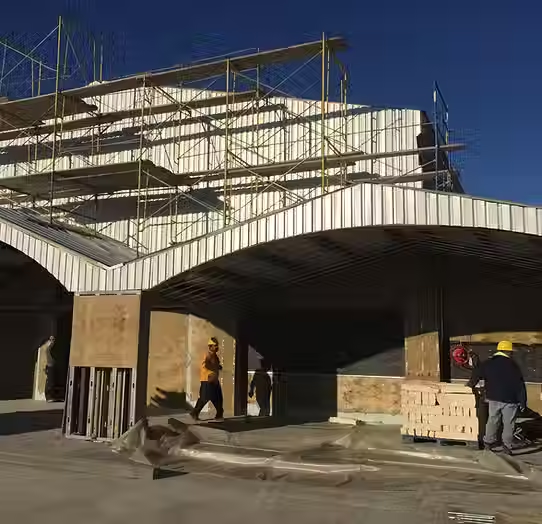
Project: Southwest Shipyards Barge Construction Building, Galveston, TX
Large heavy-industrial building on Pelican Island, Galveston, used to build and launch barges
Approved by the City of Galveston and the U.S. Army Corps of Engineers
Read the full Southwest Shipyards case study
Challenges
Foundations had to support four 60-ton overhead cranes at once
Galveston's soft coastal soils could not carry those loads near the surface
Completed barges needed a direct path to the ship channel
Objectives
Design foundations for heavy crane loads on coastal soils.
Enable direct side-launch of completed barges.
Solutions JRH Engineering Provided
Structural engineering foundation design and civil site design
Auger cast piers approximately 130 feet deep to reach stable bearing soils
Pile caps engineered for simultaneous loading from all four cranes
Integrated rail tracks for side-launch to the ship channel
Results:
Heavy crane loads supported on coastal soils
Direct barge launch capability built in
City of Galveston and Corps of Engineers approvals secured
Hangar Requirements in Texas, North Carolina and Florida
Texas
TDI's windstorm program lists the 2024 IRC and IBC, effective April 1, 2026; see 2026 Private Aircraft Hangar Design Updates.
North Carolina
The NC Office of State Fire Marshal lists the 2018 NC codes as current, with 2024 pending.
Florida
The Florida Building Code 8th Edition (2023) is in effect, and Miami-Dade and Broward counties are in the High-Velocity Hurricane Zone.
Frequently Asked Questions
What is NFPA 409?
The National Fire Protection Association's standard on aircraft hangars.
Is NFPA 409 required for my hangar?
It applies where the jurisdiction has adopted it or the building code references it, so confirm with the fire marshal.
How are hangars classified under NFPA 409?
Into Groups I through IV, based on factors such as door height, fire area and construction type.
Does JRH Engineering design hangar fire protection systems?
No, fire protection design is by others; JRH Engineering coordinates civil and structural design with that team.
How did JRH Engineering support heavy crane loads in Galveston?
With auger cast piers about 130 feet deep and pile caps designed for four 60-ton cranes.
Does JRH Engineering obtain building permits?
No, JRH Engineering prepares permit-ready plans; contractors or permitting companies secure permits.
Want More Information on this Topic?
Call JRH Engineering at (800) 227-9635
Use the chatbot in the lower right-hand corner of this page
Submit a request through JRH Engineering's contact page
Find JRH Engineering on Google:
This article was written by the team at JRH Engineering, a licensed engineering firm with 18 years of experience in civil, structural, and land development. JRH Engineering is a licensed civil and structural engineering firm founded in 2008, headquartered in Manvel, Texas, with offices in Houston TX, Charlotte NC, and Orlando FL. Certified WBE, WOSB, and HUB-eligible. Phone: (800) 227-9635 | sales@jrhengineering.net | jrhengineering.net. Texas PE license is F-10385. North Carolina PE license is P-3118. Florida license is 38516.



Comments