


Texas Aircraft Hangar Designs: Heat-Resistant Materials & Engineering
Updated: 16 hours ago

Why Choose JRH Engineering
Why Developers, Contractors & Property Owners Choose JRH
Most engineering firms talk about technical capability. We focus on what actually matters to your project: speed, cost, communication, and results.
Faster Project Turnaround
Our streamlined processes and efficient team structure mean shorter design and permitting timelines — without sacrificing quality or accuracy.
Clear & Responsive Communication
You work directly with engineers who keep you informed. No long delays or unanswered emails — just straightforward updates and quick responses.
Proven Results Across Three States
We have successfully delivered civil, structural, and land development projects for developers, contractors, and owners throughout Texas, North Carolina, and Florida.
Check out JRH's case studies.
Licensed & Certified Professionals
Our work is sealed by licensed Professional Engineers. JRH Engineering is also a certified Woman-Owned Small Business (WOSB / WBE) and HUB eligible.
Designing Hangars for Texas Heat and Humidity
Texas hangars deal with long, hot summers, Gulf Coast humidity, strong winds and expansive clay soils. All of these are easier to handle in design than after construction.
Most private hangars are pre-engineered metal buildings (PEMBs), so the foundation, wind design and slab details do much of the work.
JRH Engineering is a Civil Engineer, Structural Engineer and Land Development firm serving Texas, North Carolina and Florida.
JRH guiding principles are: Engineering Excellence. Delivered on Time. Built on Value.
Structural Considerations
Thermal movement: long steel frames expand and contract as temperatures swing, so connections and joints should allow for movement
Wind loads: design follows the locally adopted building code and ASCE 7; large hangar doors create big openings that affect wind pressures
Corrosion: humid and coastal sites call for protective coatings and attention to connections and anchor bolts
Coastal certification: in Brazoria and Galveston counties, JRH supports TDI windstorm certification with WPI-8 documentation
Slab and Foundation Considerations
Vapor retarder: a vapor retarder under the slab, such as one meeting ASTM E1745, limits moisture rising through the floor
Expansive soils: drilled piers or grade beams resist clay movement
Aircraft loads: slab thickness and reinforcement are sized for the aircraft and equipment the hangar will hold
Site Considerations
Grading, drainage and detention pond storage where local rules require it
FAA notice on Form 7460-1, filed at least 45 days ahead, for structures near airports that meet 14 CFR Part 77 thresholds
What JRH Does Not Design
Insulation, HVAC, dehumidification and ventilation (MEP by others)
Fire protection systems, including NFPA 409 hangar requirements (by others)
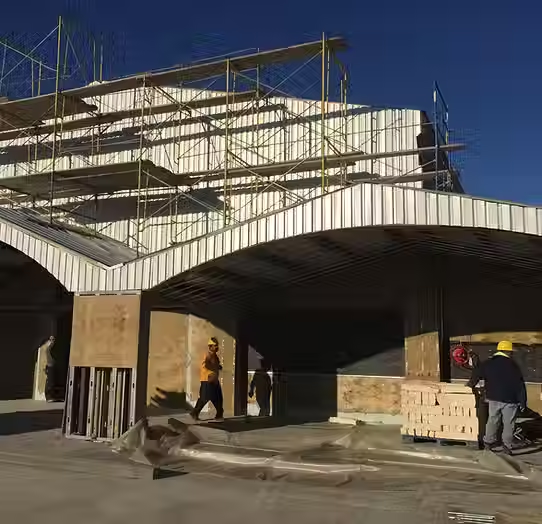
Project: PEMB Foundation, Katy, TX
This project wasn't a hangar, but it shows the same kind of metal building foundation a hangar needs.
70 ft x 40 ft pre-engineered metal building foundation in Katy, TX
Structural plans completed July 2025
Challenges
Site soils called for pier support under the grade beams
Objectives
Resist soil movement under the slab.
Anchor the metal building frame securely.
Solutions JRH Engineering Provided
Structural engineering foundation plan and details
18 in. drilled piers with 4 ft belled bases under the grade beams
6 in. slab (3,500 psi) with #4 bars at 16 in. each way on a vapor barrier
Hairpin bars wrapped around the anchor bolts to carry column thrust into the slab
Results:
PE-sealed foundation package ready for permitting
Hangar Design in Texas, North Carolina and Florida
Texas
North Carolina
The NC Office of State Fire Marshal lists the state's current building codes.
Florida
The Florida Building Code 8th Edition (2023) references ASCE 7-22 wind provisions.
Frequently Asked Questions
How does Texas heat affect hangar design?
Temperature swings cause steel frames to expand and contract, so connections should allow movement.
Why does a hangar slab need a vapor retarder?
It limits moisture rising through the slab, which matters in humid climates.
Do hangars need special wind design?
Yes, large door openings affect wind pressures under ASCE 7 and the local code.
Does a hangar near an airport need FAA review?
Structures meeting 14 CFR Part 77 thresholds need FAA notice at least 45 days before construction.
Does JRH Engineering design hangar HVAC or fire protection?
No, MEP and fire protection are designed by others.
Does JRH Engineering obtain building permits?
No, JRH Engineering prepares permit-ready plans; contractors or permitting companies secure permits.
Want More Information on this Topic?
Call JRH Engineering at (800) 227-9635
Use the chatbot in the lower right-hand corner of this page
Submit a request through JRH Engineering's contact page
Find JRH Engineering on Google:
This article was written by the team at JRH Engineering, a licensed engineering firm with 18 years of experience in civil, structural, and land development. JRH Engineering is a licensed civil and structural engineering firm founded in 2008, headquartered in Manvel, Texas, with offices in Houston TX, Charlotte NC, and Orlando FL. Certified WBE, WOSB, and HUB-eligible. Phone: (800) 227-9635 | sales@jrhengineering.net | jrhengineering.net. Texas PE license is F-10385. North Carolina PE license is P-3118. Florida license is 38516.



Comments