


Post‑Ian Stormwater Detention: Orange County vs. Miami‑Dade
Updated: 4 days ago

Why Choose JRH Engineering
Why Developers, Contractors & Property Owners Choose JRH
Most engineering firms talk about technical capability. We focus on what actually matters to your project: speed, cost, communication, and results.
Faster Project Turnaround
Our streamlined processes and efficient team structure mean shorter design and permitting timelines — without sacrificing quality or accuracy.
Clear & Responsive Communication
You work directly with engineers who keep you informed. No long delays or unanswered emails — just straightforward updates and quick responses.
Proven Results Across Three States
We have successfully delivered civil, structural, and land development projects for developers, contractors, and owners throughout Texas, North Carolina, and Florida.
Check out JRH's case studies.
Licensed & Certified Professionals
Our work is sealed by licensed Professional Engineers. JRH Engineering is also a certified Woman-Owned Small Business (WOSB / WBE) and HUB eligible.
Why Hurricane Ian Changed the Stormwater Conversation
In September 2022, Hurricane Ian's rain flooded neighborhoods far inland, including parts of Central Florida. Since then, owners and reviewers in Orange County and Miami-Dade have paid closer attention to stormwater storage.
The two counties share state rules, but their ground conditions are very different. That means detention pond design looks different in each.
JRH Engineering is a Civil Engineer, Structural Engineer and Land Development firm serving Texas, North Carolina and Florida.
JRH guiding principles are: Engineering Excellence. Delivered on Time. Built on Value.
What Both Counties Share
Florida's Environmental Resource Permit (ERP) program covers stormwater treatment and storage for most new development
ERP review is handled by FDEP or a water management district. Most of Orange County is in the St. Johns River Water Management District, and Miami-Dade is in the South Florida Water Management District, so confirm the reviewing agency for each site
Florida's statewide stormwater treatment criteria were updated after the 2020 Clean Waterways Act; confirm which version applies to a project's application date
Orange County: Sandy Soils and Lakes
Well-drained sandy soils in many areas make retention and infiltration practical
Many sites drain to lakes or closed basins, which raises the stakes on storage volume
The Orange County Code, Chapter 30, sets the county's stormwater treatment and rate-control criteria; verify current requirements with the county before design
Miami-Dade: High Groundwater and Tight Sites
A shallow water table limits how deep a pond or infiltration system can work
Dense parcels leave little room for surface ponds
Exfiltration trenches, underground storage and drainage wells are common tools, subject to county and state approval
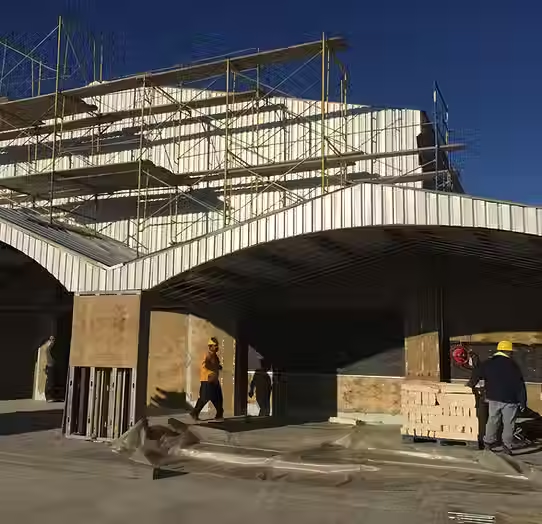
Project: Small-Bay Warehouse Site Development, Cocoa, FL
This project is in Brevard County, not Orange or Miami-Dade. It still shows the same trade-off between stormwater and usable land on a Florida site.
25,000–30,000 SF small-bay warehouse with tractor-trailer dock access in Cocoa, Brevard County
Read the full Cocoa warehouse case study
Challenges
Docks, truck turning radii and staging competed with stormwater for the same land
Objectives
Size detention pond storage for the full impervious area.
Deliver a complete civil package for county permitting.
Solutions JRH Engineering Provided
Civil engineering site plan, grading, drainage, SWPPP and paving
Truck areas set first, with the stormwater system designed around them
Detention pond analysis sized for the full warehouse and pavement area
Results:
Detention pond storage met Brevard County criteria without compromising truck areas
Stormwater Design in Florida, Texas and North Carolina
Florida
See the FDEP Environmental Resource Permit and construction stormwater pages, plus Navigating Florida Stormwater Rules and Stormwater Injection Wells.
Texas
Houston and Harris County set their own detention pond criteria; see Detention Pond Design for Regulatory Compliance.
North Carolina
Erosion control plans for more than one acre need approval under G.S. 113A-57.
Frequently Asked Questions
Who reviews stormwater permits in Orange County and Miami-Dade?
The county, plus FDEP or the water management district through the ERP program.
Why is detention pond design different in Miami-Dade?
High groundwater and tight urban sites limit surface ponds and infiltration depth.
Why does retention work well in parts of Orange County?
Many areas have well-drained sandy soils that let runoff infiltrate.
What are alternatives to a surface pond?
Exfiltration trenches, underground storage and, where approved, drainage wells.
Did stormwater rules change after Hurricane Ian?
Florida updated statewide treatment criteria after the 2020 Clean Waterways Act; confirm the version that applies to your application.
Does JRH Engineering obtain building permits?
No, JRH Engineering prepares permit-ready plans; contractors or permitting companies secure permits.
Want More Information on this Topic?
Call JRH Engineering at (800) 227-9635
Use the chatbot in the lower right-hand corner of this page
Submit a request through JRH Engineering's contact page
Find JRH Engineering on Google:
This article was written by the team at JRH Engineering, a licensed engineering firm with 18 years of experience in civil, structural, and land development. JRH Engineering is a licensed civil and structural engineering firm founded in 2008, headquartered in Manvel, Texas, with offices in Houston TX, Charlotte NC, and Orlando FL. Certified WBE, WOSB, and HUB-eligible. Phone: (800) 227-9635 | sales@jrhengineering.net | jrhengineering.net. Texas PE license is F-10385. North Carolina PE license is P-3118. Florida license is 38516.



Comments