


Why Houston's Flood-Prone Areas Need Civil Engineers for Land Development
Updated: Oct 2

Why Choose JRH Engineering
Why Developers, Contractors & Property Owners Choose JRH
Most engineering firms talk about technical capability. We focus on what actually matters to your project: speed, cost, communication, and results.
Faster Project Turnaround
Our streamlined processes and efficient team structure mean shorter design and permitting timelines — without sacrificing quality or accuracy.
Clear & Responsive Communication
You work directly with engineers who keep you informed. No long delays or unanswered emails — just straightforward updates and quick responses.
Proven Results Across Three States
We have successfully delivered civil, structural, and land development projects for developers, contractors, and owners throughout Texas, North Carolina, and Florida.
Check out JRH's case studies.
Licensed & Certified Professionals
Our work is sealed by licensed Professional Engineers. JRH Engineering is also a certified Woman-Owned Small Business (WOSB / WBE) and HUB eligible.
Why Flood-Prone Houston Land Needs a Civil Engineer First
In Houston, the floodplain, the detention pond and the outfall decide what a property can hold. A site that looks buildable can lose acreage to storage, fill rules or elevation requirements once the drainage review starts.
A civil engineer finds those limits before design, when they are cheapest to solve.
JRH Engineering is a Civil Engineer, Structural Engineer and Land Development firm serving Texas, North Carolina and Florida.
JRH guiding principles are: Engineering Excellence. Delivered on Time. Built on Value.
Rainfall Standards Changed After Harvey
NOAA Atlas 14 raised design rainfall depths across the Houston region
HCFCD published its 2019 Atlas 14 Policy Criteria and Procedures Manual to apply the new data
Older drainage studies may understate today's storage and elevation needs
Who Reviews Houston-Area Sites
City of Houston: Infrastructure Design Manual Chapter 9 and Supplement IDMS-2025-01, which uses 0.8 ac-ft of detention pond storage per acre of new impervious area for non-single-family tracts of 20 acres or less
Harris County and HCFCD: floodplain and drainage rules in unincorporated areas
Drainage districts, MUDs and TxDOT where they apply
Civil Engineering Tools for Flood-Prone Sites
Floodplain analysis and base flood elevation designation
Grading and fill balance to set pads above flood levels without importing more fill than needed
Detention pond design that protects buildable land
Credits for existing infrastructure when a regional or neighborhood system already has capacity
Where Structural Engineering Fits
Elevated slabs and pier foundations for floodplain lots
Foundations designed for expansive clay
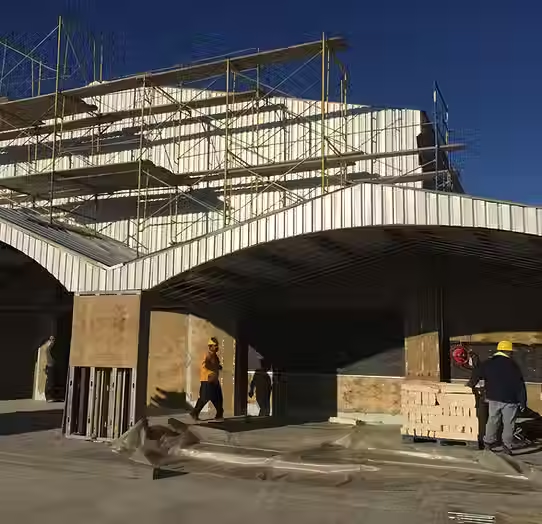
Project: Southbelt Warehouse Expansion, Houston, TX
Manufacturing warehouse expansion in Houston, Harris County, within the 500-year floodplain
Reviewed by the City of Houston, with an HOA involved
Read the full Southbelt case study
Challenges
The expansion had been built without permits, violating HOA requirements
The 500-year floodplain location triggered floodplain review
Objectives
Resolve the HOA violation.
Obtain a retroactive City of Houston permit.
Achieve floodplain compliance without new detention pond construction.
Solutions JRH Engineering Provided
Civil engineering floodplain analysis and BFE designation
Documentation that the expansion was less than 50% of the existing structure's value, under the substantial improvement threshold
Analysis showing the existing neighborhood detention pond system had capacity for the added impervious area
Results:
City of Houston permit issued and HOA violation resolved
Floodplain compliance achieved under the 50% threshold
New detention pond construction avoided
Flood-Prone Development in Texas, North Carolina and Florida
Texas
North Carolina
Check flood zones on the state's Flood Risk Information System.
Florida
Check flood zones on FEMA's Flood Map Service Center.
Frequently Asked Questions
Can I develop land in the 500-year floodplain?
Often yes, with floodplain review and any required elevation or mitigation.
What is the substantial improvement threshold?
An improvement equal to 50% or more of a structure's market value generally triggers full floodplain compliance.
What is a "no-rise" certification?
An engineer's analysis showing work in a floodway will not raise base flood elevations.
What is Atlas 14?
NOAA's updated rainfall frequency data, which raised design rainfall in the Houston region.
Can existing detention pond capacity be credited?
Sometimes, as at Southbelt, where neighborhood capacity covered the expansion.
Does JRH Engineering obtain building permits?
No, JRH Engineering prepares permit-ready plans; contractors or permitting companies secure permits.
Want More Information on this Topic?
Call JRH Engineering at (800) 227-9635
Use the chatbot in the lower right-hand corner of this page
Submit a request through JRH Engineering's contact page
Find JRH Engineering on Google:
This article was written by the team at JRH Engineering, a licensed engineering firm with 18 years of experience in civil, structural, and land development. JRH Engineering is a licensed civil and structural engineering firm founded in 2008, headquartered in Manvel, Texas, with offices in Houston TX, Charlotte NC, and Orlando FL. Certified WBE, WOSB, and HUB-eligible. Phone: (800) 227-9635 | sales@jrhengineering.net | jrhengineering.net. Texas PE license is F-10385. North Carolina PE license is P-3118. Florida license is 38516.



Comments