


Flood Mitigation Strategies for Eastern NC and Southern TX
Updated: Oct 14

Why Choose JRH Engineering
Why Developers, Contractors & Property Owners Choose JRH
Most engineering firms talk about technical capability.
We focus on what actually matters to your project: speed, cost, communication, and results.
Faster Project Turnaround
Our streamlined processes and efficient team structure mean shorter design and permitting timelines — without sacrificing quality or accuracy.
Clear & Responsive Communication
You work directly with engineers who keep you informed.
No long delays or unanswered emails — just straightforward updates and quick responses.
Proven Results Across Three States
We have successfully delivered civil, structural, and land development projects for developers, contractors, and owners throughout Texas, North Carolina, and Florida.
Check out JRH’s case studies.
Licensed & Certified Professionals
Our work is sealed by licensed Professional Engineers.
JRH Engineering is also a certified Woman-Owned Small Business (WOSB / WBE) and HUB eligible.
Flood Risk in Eastern North Carolina and Southern Texas
Eastern North Carolina and the Texas Gulf Coast share low, flat terrain, heavy rainfall and hurricane exposure.
Sites that ignore flood risk pay for it later in damage, redesign or failed review. Sites designed for it hold up better and are easier to approve.
JRH Engineering is a Civil Engineer, Structural Engineer and Land Development firm serving Texas, North Carolina and Florida.
JRH guiding principles are: Engineering Excellence. Delivered on Time. Built on Value.
Site-Level Flood Mitigation Strategies
Know the flood zone: check FEMA maps and local floodplain rules before buying or designing
Raise finished floors: set floors and pads above the base flood elevation plus any local freeboard
Manage runoff on site: detention pond storage, underground storage or permeable paving
Grade away from buildings: positive drainage to swales, inlets and outfalls
Size culverts and storm sewers: for the local design storm and downstream conditions
Design foundations for the site: elevated slabs or piers where floodplain rules require
Common Challenges
Limited land for detention pond storage on small or infill sites
Flat sites with little fall to an outfall
Downstream systems already at capacity
Changing flood maps during design
Rules to Know
North Carolina: erosion control plans for more than 1 acre need approval under G.S. 113A-57, and post-construction stormwater rules apply under 15A NCAC 02H .1000.
The 2018 NC codes remain current.
Texas: sites disturbing 1 acre or more need TCEQ construction stormwater coverage.
In the City of Houston, Supplement IDMS-2025-01 requires 0.8 acre-feet of detention pond storage per acre for non-single-family tracts of 20 acres or less.
Levees, coastal shoreline structures and wetland or environmental studies are by others.
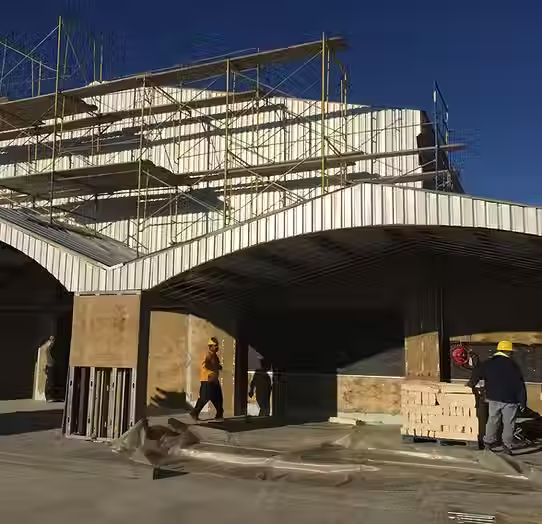
Project: Hometown Bank Class A Replacement, Galveston, TX
This coastal Texas site shows on-site stormwater on a tight footprint.
Bank demolition and new Class A building in Galveston
Reviewed by the City of Galveston
Read the full Hometown Bank case study
Challenges
Limited land left little room for a detention pond
Coastal floodplain rules required a higher finished floor
Objectives
Solve stormwater without losing usable land.
Deliver a clean first City submittal.
Solutions JRH Engineering Provided
Full civil engineering and stormwater design
Permeable paving across the site to infiltrate stormwater on site
A design that qualified for the City of Galveston detention pond exemption
Results:
No traditional detention pond needed
Clean first City submittal with no mid-review changes
Flood Resources for North Carolina, Texas and Florida
North Carolina
Texas
Florida
See FDEP’s Environmental Resource Permit program.
Frequently Asked Questions
What is the first step in flood mitigation for a site?
Confirm the flood zone and local floodplain rules before design.
Can permeable paving replace a detention pond?
Sometimes; at Hometown Bank it qualified the site for a City of Galveston exemption.
When is an erosion control plan needed in North Carolina?
When a project disturbs more than 1 acre.
How much detention pond storage does Houston require?
0.8 acre-feet per acre for non-single-family tracts of 20 acres or less.
Does JRH design levees or seawalls?
No, levees and coastal shoreline structures are by others.
Does JRH Engineering obtain building permits?
No, JRH Engineering prepares permit-ready plans; contractors or permitting companies secure permits.
Want More Information on this Topic?
Call JRH Engineering at (800) 227-9635
Use the chatbot in the lower right-hand corner of this page
Submit a request through JRH Engineering’s contact page
Find JRH Engineering on Google:
This article was written by the team at JRH Engineering, a licensed engineering firm with 18 years of experience in civil, structural, and land development. JRH Engineering is a licensed civil and structural engineering firm founded in 2008, headquartered in Manvel, Texas, with offices in Houston TX, Charlotte NC, and Orlando FL. Certified WBE, WOSB, and HUB-eligible. Phone: (800) 227-9635 | sales@jrhengineering.net | jrhengineering.net. Texas PE license is F-10385. North Carolina PE license is P-3118. Florida license is 38516.



Comments