


Florida Stormwater Navigation: A Developer’s Guide
Updated: Oct 9

Why Choose JRH Engineering
Why Developers, Contractors & Property Owners Choose JRH
Most engineering firms talk about technical capability.
We focus on what actually matters to your project: speed, cost, communication, and results.
Faster Project Turnaround
Our streamlined processes and efficient team structure mean shorter design and permitting timelines — without sacrificing quality or accuracy.
Clear & Responsive Communication
You work directly with engineers who keep you informed.
No long delays or unanswered emails — just straightforward updates and quick responses.
Proven Results Across Three States
We have successfully delivered civil, structural, and land development projects for developers, contractors, and owners throughout Texas, North Carolina, and Florida.
Check out JRH’s case studies.
Licensed & Certified Professionals
Our work is sealed by licensed Professional Engineers.
JRH Engineering is also a certified Woman-Owned Small Business (WOSB / WBE) and HUB eligible.
Florida’s Stormwater Rules for Developers
Florida stormwater permitting changed in 2024. Knowing which rules apply, and when, helps developers plan layouts and budgets early.
JRH Engineering is a Civil Engineer, Structural Engineer and Land Development firm serving Texas, North Carolina and Florida, with an office in Orlando.
JRH guiding principles are: Engineering Excellence. Delivered on Time. Built on Value.
Environmental Resource Permits
Most stormwater systems in Florida need an Environmental Resource Permit (ERP) under Chapter 62-330, Florida Administrative Code
ERPs are issued by FDEP or one of five water management districts, which handle most residential and commercial projects
Applicant’s Handbook Volume I sets statewide criteria; Volume II adds district-specific flood protection and basin criteria
The 2024 Stormwater Rule Update
CS/SB 7040 (Chapter 2024-275, Laws of Florida) was signed June 28, 2024, ratifying updated rule 62-330.010
Per FDEP, the new performance standards apply to applications deemed complete after December 28, 2025
Nutrient treatment for total nitrogen and total phosphorus is based on the project’s HUC 12 watershed; projects in watersheds without impaired waters or Outstanding Florida Waters must also show a net improvement
Applicants submit a Certification of Financial Capability for the perpetual operation and maintenance entity
For permits issued after June 28, 2024, required inspections after June 28, 2025 must be done by a qualified inspector
Construction Stormwater
Sites disturbing 1 acre or more, or part of a larger common plan, need coverage under FDEP’s construction generic permit
A Notice of Intent is filed at least 2 days before construction, with a SWPPP in place
Design Considerations
Seasonal high groundwater controls how deep a pond can go
Sandy soils can support retention and infiltration where groundwater allows
Wet detention ponds, dry retention and underground systems each fit different sites
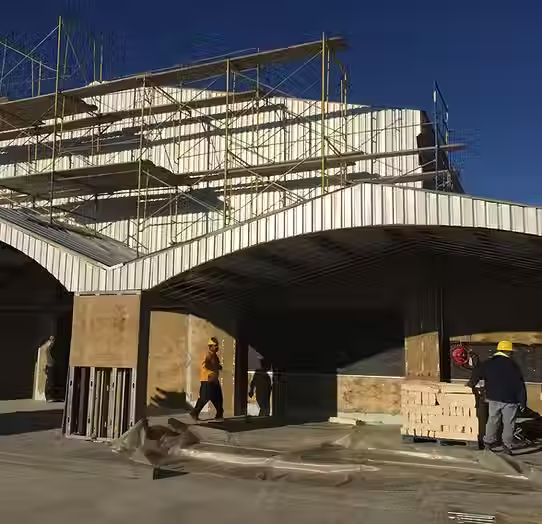
Project: Small-Bay Warehouse Site Development, Cocoa, FL
25,000–30,000 SF small-bay warehouse with tractor-trailer dock access in Cocoa, Brevard County
Read the full Cocoa warehouse case study
Challenges
Docks, truck turning radii and staging competed with stormwater for the same land
Objectives
Size detention pond storage for the full impervious area.
Deliver a complete civil package for county permitting.
Solutions JRH Engineering Provided
Civil engineering site plan, grading, drainage, SWPPP and paving
Truck areas set first, with the stormwater system designed around them
Detention pond analysis sized for the full warehouse and pavement area
Results:
Detention pond storage met Brevard County criteria without compromising truck areas
Stormwater Rules in Florida, Texas and North Carolina
Florida
Texas
Sites disturbing 1 acre or more need TCEQ construction stormwater coverage.
North Carolina
Frequently Asked Questions
What permit covers stormwater systems in Florida?
Usually an Environmental Resource Permit from FDEP or a water management district.
When did Florida’s new stormwater rules take effect?
The rule was ratified June 28, 2024; per FDEP, the new standards apply to applications deemed complete after December 28, 2025.
What do the new standards require?
Total nitrogen and total phosphorus treatment based on the project’s HUC 12 watershed, plus net improvement in some areas.
Who inspects stormwater systems under the new rules?
For permits issued after June 28, 2024, a qualified inspector performs required inspections after June 28, 2025.
When is construction stormwater coverage needed?
For sites disturbing 1 acre or more, with a Notice of Intent filed at least 2 days before construction.
Does JRH Engineering obtain building permits?
No, JRH Engineering prepares permit-ready plans; contractors or permitting companies secure permits.
Want More Information on this Topic?
Call JRH Engineering at (800) 227-9635
Use the chatbot in the lower right-hand corner of this page
Submit a request through JRH Engineering’s contact page
Find JRH Engineering on Google:
This article was written by the team at JRH Engineering, a licensed engineering firm with 18 years of experience in civil, structural, and land development. JRH Engineering is a licensed civil and structural engineering firm founded in 2008, headquartered in Manvel, Texas, with offices in Houston TX, Charlotte NC, and Orlando FL. Certified WBE, WOSB, and HUB-eligible. Phone: (800) 227-9635 | sales@jrhengineering.net | jrhengineering.net. Texas PE license is F-10385. North Carolina PE license is P-3118. Florida license is 38516.



Comments