

Toyota's $3.6B TX Expansion Signals Industrial Growth Ahead
Updated: Oct 14

Why Choose JRH Engineering
Why Developers, Contractors & Property Owners Choose JRH
Most engineering firms talk about technical capability.
We focus on what actually matters to your project: speed, cost, communication, and results.
Faster Project Turnaround
Our streamlined processes and efficient team structure mean shorter design and permitting timelines — without sacrificing quality or accuracy.
Clear & Responsive Communication
You work directly with engineers who keep you informed.
No long delays or unanswered emails — just straightforward updates and quick responses.
Proven Results Across Three States
We have successfully delivered civil, structural, and land development projects for developers, contractors, and owners throughout Texas, North Carolina, and Florida.
Check out JRH’s case studies.
Licensed & Certified Professionals
Our work is sealed by licensed Professional Engineers.
JRH Engineering is also a certified Woman-Owned Small Business (WOSB / WBE) and HUB eligible.
What Toyota’s Expansion Means for Texas Industry
Toyota has announced a $3.6 billion expansion of its San Antonio manufacturing campus that moves Tacoma pickup production from Baja California, Mexico, to Texas and adds more than 2,000 jobs.
A project of that scale signals more heavy industrial and manufacturing construction ahead, and with it more demand for suppliers, warehouses and the sites that serve them.
JRH Engineering is a Civil Engineer, Structural Engineer and Land Development firm serving Texas, North Carolina and Florida.
JRH guiding principles are: Engineering Excellence. Delivered on Time. Built on Value.
What Heavy Industrial Sites Need
Deep foundations: heavy equipment and crane loads often need piers or piles that reach stable soil
Large building pads: mass grading for big, flat floors
Truck and rail access: drive aisles, turning radii and, on some sites, rail spurs
Stormwater: detention pond storage for large roofs and paved yards
Utilities: water and sewer capacity confirmed with the provider
Planning Tips for Industrial Owners
Get a geotechnical report (by others) before foundation design starts.
Define crane, equipment and floor loads early.
Confirm utility capacity and access during feasibility.
Plan stormwater storage into the site layout from the start.
Coordinate civil and structural design so pads, elevations and foundations match.
Sites disturbing 1 acre or more in Texas need TCEQ construction stormwater coverage.
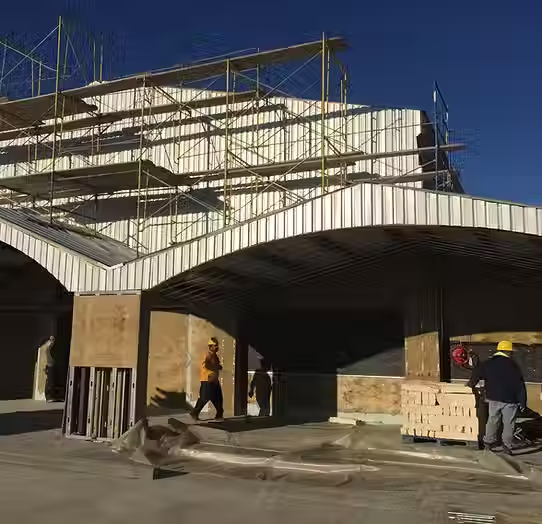
Project: Southwest Shipyards Barge Construction Building, Galveston, TX
This Galveston County facility shows the foundation and site design heavy industrial projects demand.
Heavy industrial building on Pelican Island, Galveston, used to build and launch barges
Read the full Southwest Shipyards case study
Challenges
Soft coastal soils could not carry heavy loads near the surface
Foundations had to support four 60-ton overhead cranes at once
Objectives
Reach stable bearing soils below the soft surface layers.
Support simultaneous crane loads.
Enable direct side-launch of completed barges.
Solutions JRH Engineering Provided
Structural engineering foundation design
Auger cast piers about 130 feet deep to reach stable bearing strata
Pile caps engineered for simultaneous loading from all four cranes
Integrated rail tracks for side-launch to the ship channel
Results:
Crane loads supported on coastal soils
Direct barge launch capability built in, with no separate launch facility
Industrial Development in Texas, North Carolina and Florida
Texas
North Carolina
North Carolina continues to see industrial site activity, especially in the Piedmont. Erosion control plans for more than 1 acre need approval under G.S. 113A-57.
Florida
Florida’s industrial and logistics growth follows population and distribution demand. See FDEP’s Environmental Resource Permit program.
Frequently Asked Questions
What does Toyota’s expansion mean for Texas industrial sites?
More heavy industrial and supplier construction, with more demand for sites, foundations and infrastructure.
Why do heavy industrial buildings need deep foundations?
Crane and equipment loads often exceed what near-surface soils can carry.
What foundation did Southwest Shipyards use?
Auger cast piers about 130 feet deep with pile caps for four 60-ton cranes.
When is TCEQ construction stormwater coverage needed?
When a Texas site disturbs 1 acre or more.
Does JRH perform geotechnical investigations?
No, geotechnical reports are by others.
Does JRH Engineering obtain building permits?
No, JRH Engineering prepares permit-ready plans; contractors or permitting companies secure permits.
Want More Information on this Topic?
Call JRH Engineering at (800) 227-9635
Use the chatbot in the lower right-hand corner of this page
Submit a request through JRH Engineering’s contact page
Find JRH Engineering on Google:
This article was written by the team at JRH Engineering, a licensed engineering firm with 18 years of experience in civil, structural, and land development. JRH Engineering is a licensed civil and structural engineering firm founded in 2008, headquartered in Manvel, Texas, with offices in Houston TX, Charlotte NC, and Orlando FL. Certified WBE, WOSB, and HUB-eligible. Phone: (800) 227-9635 | sales@jrhengineering.net | jrhengineering.net. Texas PE license is F-10385. North Carolina PE license is P-3118. Florida license is 38516.



Comments