


New Hwy 249 Warehouse Signals Harris Co. Industrial Growth
Updated: Oct 13

Why Choose JRH Engineering
Why Developers, Contractors & Property Owners Choose JRH
Most engineering firms talk about technical capability.
We focus on what actually matters to your project: speed, cost, communication, and results.
Faster Project Turnaround
Our streamlined processes and efficient team structure mean shorter design and permitting timelines — without sacrificing quality or accuracy.
Clear & Responsive Communication
You work directly with engineers who keep you informed.
No long delays or unanswered emails — just straightforward updates and quick responses.
Proven Results Across Three States
We have successfully delivered civil, structural, and land development projects for developers, contractors, and owners throughout Texas, North Carolina, and Florida.
Check out JRH’s case studies.
Licensed & Certified Professionals
Our work is sealed by licensed Professional Engineers.
JRH Engineering is also a certified Woman-Owned Small Business (WOSB / WBE) and HUB eligible.
A New Highway 249 Warehouse and What It Signals
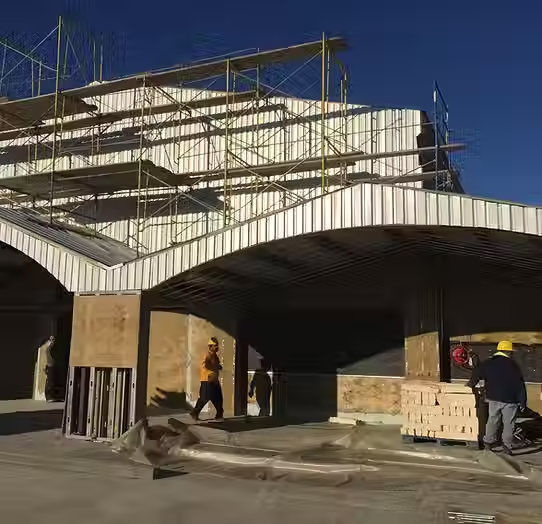
A newly announced 14.4-acre warehouse site on Highway 249 in Harris County is a sign of steady industrial demand along the corridor northwest of Houston.
Sites like this face the same engineering questions: how much land the detention pond takes, where water and sewer come from, and how trucks get on and off a state highway.
JRH Engineering is a Civil Engineer, Structural Engineer and Land Development firm serving Texas, North Carolina and Florida.
JRH guiding principles are: Engineering Excellence. Delivered on Time. Built on Value.
Key Decisions for a Highway 249 Industrial Site
Detention pond footprint: storage requirements can claim acreage needed for buildings, truck courts and trailer parking
TxDOT drainage criteria: sites draining to TxDOT right-of-way in the Houston District follow tract-size tiers, starting at 0.85 acre-feet per acre of disturbed area for sites up to 2 acres; sites over 10 acres need a pre-application meeting with TxDOT Houston District Hydraulics
Highway access: driveway location, spacing and turn lanes need TxDOT coordination
Utilities: some corridor tracts lack municipal water and sewer, which affects cost and schedule
Construction stormwater: sites disturbing 1 acre or more need TCEQ permit coverage
Plan Before You Buy
Confirm who reviews drainage: the county, a city, a drainage district or TxDOT.
Check utility availability and capacity.
Test detention pond placement against the building and truck court layout.
Start TxDOT access coordination early.
For more on state highway sites, see Avoid Costly Surprises: How TxDOT’s New Drainage Criteria Impact Commercial Site Feasibility.
Project: Kobs Rd. Office & Warehouse Complex, Tomball, TX
8.1-acre office, warehouse and laydown yard complex in Tomball, Montgomery County
Read the full Kobs Rd. case study
Challenges
No municipal water or sanitary sewer
Significant elevation changes complicated layout and drainage
Objectives
Protect high-value front acreage for buildings.
Avoid utility extension delays.
Solutions JRH Engineering Provided
Civil engineering site design permitted through Montgomery County
The detention pond placed at the rear, using the site’s lower elevations
A lift station to reduce the pond footprint
A private well and septic approach in place of municipal utility extensions (septic design by others)
Results:
Premium front acreage protected for buildings
Smaller detention pond and lower infrastructure cost
Industrial Site Resources for Texas, North Carolina and Florida
Texas
North Carolina
See G.S. 113A-57 for erosion control plans on more than 1 acre.
Florida
See FDEP’s Environmental Resource Permit program.
Frequently Asked Questions
Where should a detention pond go on an industrial site?
Often at the rear or low point, keeping frontage for buildings and truck access.
What if a site has no municipal water or sewer?
Private well and septic or alternative utility strategies may work; septic design is by others.
Do TxDOT drainage criteria apply to Highway 249 sites?
They apply to sites draining to TxDOT right-of-way in the Houston District.
What do sites over 10 acres need from TxDOT?
A pre-application meeting with TxDOT Houston District Hydraulics before design.
When is a TCEQ stormwater permit needed?
When construction disturbs 1 acre or more.
Does JRH Engineering obtain building permits?
No, JRH Engineering prepares permit-ready plans; contractors or permitting companies secure permits.
Want More Information on this Topic?
Call JRH Engineering at (800) 227-9635
Use the chatbot in the lower right-hand corner of this page
Submit a request through JRH Engineering’s contact page
Find JRH Engineering on Google:
This article was written by the team at JRH Engineering, a licensed engineering firm with 18 years of experience in civil, structural, and land development. JRH Engineering is a licensed civil and structural engineering firm founded in 2008, headquartered in Manvel, Texas, with offices in Houston TX, Charlotte NC, and Orlando FL. Certified WBE, WOSB, and HUB-eligible. Phone: (800) 227-9635 | sales@jrhengineering.net | jrhengineering.net. Texas PE license is F-10385. North Carolina PE license is P-3118. Florida license is 38516.



Comments