


Barndominium & Rural Land Development TX NC FL | JRH Engineering
Updated: Oct 5

Why Choose JRH Engineering
Why Developers, Contractors & Property Owners Choose JRH
Most engineering firms talk about technical capability. We focus on what actually matters to your project: speed, cost, communication, and results.
Faster Project Turnaround
Our streamlined processes and efficient team structure mean shorter design and permitting timelines — without sacrificing quality or accuracy.
Clear & Responsive Communication
You work directly with engineers who keep you informed. No long delays or unanswered emails — just straightforward updates and quick responses.
Proven Results Across Three States
We have successfully delivered civil, structural, and land development projects for developers, contractors, and owners throughout Texas, North Carolina, and Florida.
Check out JRH's case studies.
Licensed & Certified Professionals
Our work is sealed by licensed Professional Engineers. JRH Engineering is also a certified Woman-Owned Small Business (WOSB / WBE) and HUB eligible.
Rural Land Development: Barndominiums, Detention Ponds & SWPPP
As rural and suburban areas of Texas, North Carolina and Florida grow, more owners are building barndominiums, large-lot subdivisions and ranch properties.
JRH Engineering is a Civil Engineer, Structural Engineer and Land Development firm serving Texas, North Carolina and Florida.
JRH guiding principles are: Engineering Excellence. Delivered on Time. Built on Value.
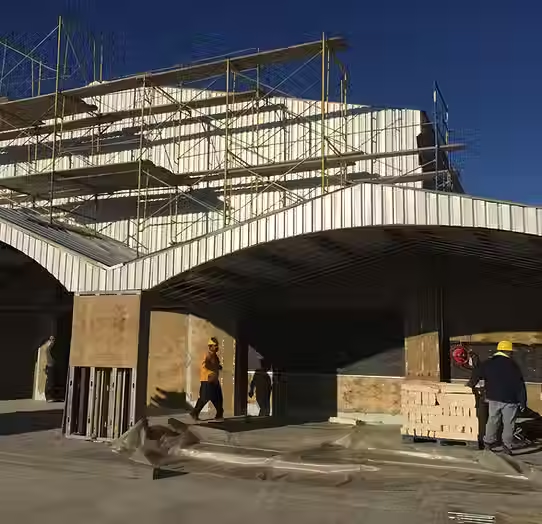
Barndominium Engineering
A structural engineer typically provides:
Foundation design for the site soils
Anchor bolt and column base coordination with the metal building supplier
Wind load design under the locally adopted code
Permit rules vary from place to place. Some rural counties have few building permit requirements, but lenders and insurers often still ask for engineered plans.
In Brazoria and Galveston counties, JRH supports TDI windstorm (WPI-8) certification.
When Is a Detention Pond Required?
When a project adds impervious cover such as roofs, drives and parking
When county or city rules limit post-development runoff to pre-development rates
In the City of Houston, IDMS-2025-01 requires 0.8 acre-feet per acre of proposed impervious area for many non-single-family tracts of 20 acres or less; nearby counties set their own criteria
A civil engineer maps the drainage areas, models the runoff and sizes the pond. The engineer also designs the outlet, spillway and grading.
When Is a SWPPP Required?
Texas: sites disturbing 1 acre or more, or part of a larger common plan, need TCEQ Construction General Permit coverage and a SWP3 before construction
North Carolina: erosion and sedimentation control plans are required for land disturbance of more than 1 acre under G.S. 113A-57
Florida: sites of 1 acre or more need FDEP construction stormwater coverage
Project: FM 149 Private Road Neighborhood, Grimes County, TX
140-acre private road neighborhood near Anderson, Grimes County
Coordination with the county, TxDOT and the fire marshal
Read the Phase 1 case study
Challenges
A limited construction budget needed funding before lot sales began
Detention pond storage was needed on a tight budget
Objectives
Generate construction capital early.
Meet drainage rules at low cost.
Solutions JRH Engineering Provided
Land development and civil engineering: subdivision planning, site design and drainage
Eight FM 149 frontage lots subdivided and sold first to fund construction
An existing stock tank converted into a compliant detention pond by lowering the water surface and adding an outfall
Individual wells and septic systems for each lot (septic design by others)
Results:
Construction capital generated before major infrastructure work
No new detention pond construction
Sources and Related Guides
Frequently Asked Questions
Does a barndominium need engineered plans?
Often; many jurisdictions, lenders and insurers require them, especially in high-wind areas.
Does a rural property need a detention pond?
It may, if the project adds impervious cover and local rules limit runoff.
When is a SWPPP required?
Generally when construction disturbs 1 acre or more, or is part of a larger common plan.
Can an existing stock tank serve as a detention pond?
Sometimes; at FM 149, a stock tank was converted with a lowered water surface and new outfall.
Does JRH Engineering design septic systems?
No, septic design is by others; JRH shows the preliminary septic area on the site plan.
Does JRH Engineering obtain building permits?
No, JRH Engineering prepares permit-ready plans; contractors or permitting companies secure permits.
Want More Information on this Topic?
Call JRH Engineering at (800) 227-9635
Use the chatbot in the lower right-hand corner of this page
Submit a request through JRH Engineering's contact page
Find JRH Engineering on Google:
This article was written by the team at JRH Engineering, a licensed engineering firm with 18 years of experience in civil, structural, and land development. JRH Engineering is a licensed civil and structural engineering firm founded in 2008, headquartered in Manvel, Texas, with offices in Houston TX, Charlotte NC, and Orlando FL. Certified WBE, WOSB, and HUB-eligible. Phone: (800) 227-9635 | sales@jrhengineering.net | jrhengineering.net. Texas PE license is F-10385. North Carolina PE license is P-3118. Florida license is 38516.



Comments