


Texas Flooding July 2026: What Developers Must Know
Updated: 5 days ago

Why Choose JRH Engineering
Why Developers, Contractors & Property Owners Choose JRH
Most engineering firms talk about technical capability.
We focus on what actually matters to your project: speed, cost, communication, and results.
Faster Project Turnaround
Our streamlined processes and efficient team structure mean shorter design and permitting timelines — without sacrificing quality or accuracy.
Clear & Responsive Communication
You work directly with engineers who keep you informed.
No long delays or unanswered emails — just straightforward updates and quick responses.
Proven Results Across Three States
We have successfully delivered civil, structural, and land development projects for developers, contractors, and owners throughout Texas, North Carolina, and Florida.
Check out JRH’s case studies.
Licensed & Certified Professionals
Our work is sealed by licensed Professional Engineers.
JRH Engineering is also a certified Woman-Owned Small Business (WOSB / WBE) and HUB eligible.
Texas Flooding July 2026: Developer Update
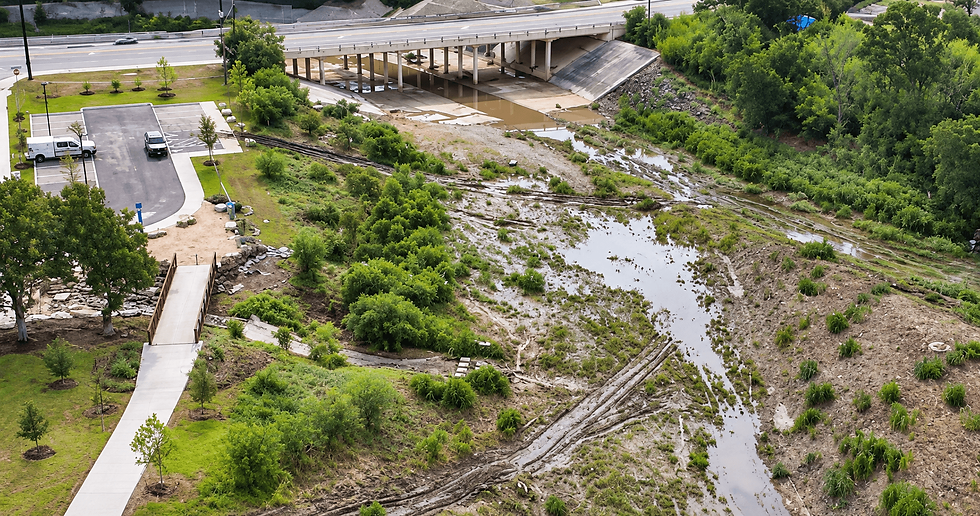
Flooding in July 2026 hit parts of the Houston metro, Southeast Texas and East Texas river basins. For developers, the effects last well after the water drops.
Saturated soils slow grading, reviewers look harder at drainage, and schedules slip.
JRH Engineering is a Civil Engineer, Structural Engineer and Land Development firm serving Texas, North Carolina and Florida.
JRH guiding principles are: Engineering Excellence. Delivered on Time. Built on Value.
How Flooding Affects Active Projects
Grading delays: wet soils make compaction targets hard to reach, so earthwork waits
Drainage scrutiny: designs based on pre-flood outfall assumptions may need updated hydraulic analysis
Foundation timing: saturated clays can affect slab and pier construction, so pours may be resequenced
Schedule impacts: review cycles and contractor availability can stretch timelines
What Developers Should Do Now
Check current FEMA flood maps and local floodplain data for every site.
Review whether detention pond storage and outfalls still match local criteria.
Ask the geotechnical engineer (by others) whether soil conditions change foundation recommendations.
Update the construction stormwater plan if site conditions changed.
Build extra time for review comments into the schedule.
Drainage Rules Worth Knowing
City of Houston: Supplement IDMS-2025-01 requires 0.8 acre-feet of detention pond storage per acre for non-single-family tracts of 20 acres or less
TxDOT Houston District: drainage guidelines effective July 1, 2025 apply to sites draining to state right-of-way
Construction stormwater: sites disturbing 1 acre or more need TCEQ construction stormwater coverage
Windstorm: JRH supports WPI-8 certification in Brazoria and Galveston counties
Project: HTeaO Shared Driveway Access, Pearland, TX
This Brazoria County site shows drainage and access designed together on a TxDOT corridor.
Restaurant site on FM 518, a TxDOT corridor in Pearland
Read the full HTeaO case study
Challenges
The site had no existing driveway on the state road
Detention pond storage had to fit without losing buildable area
Objectives
Establish highway access that meets TxDOT access management goals.
Preserve buildable area.
Solutions JRH Engineering Provided
Civil engineering: site layout, building pad, drive-through, drainage and utility coordination
A three-property shared driveway agreement negotiated before submittal
A detention pond with a retaining wall at the rear of the site
Results:
Highway access established through multi-property coordination
Maximum buildable area preserved
Flood Resources for Texas, North Carolina and Florida
Texas
North Carolina
See G.S. 113A-57.
Florida
See FDEP’s Environmental Resource Permit program.
Frequently Asked Questions
How does flooding delay site work?
Saturated soils prevent proper compaction, so grading and foundation work may pause.
Will my drainage design need updating?
Possibly, if outfall conditions or local criteria have changed since design.
How much detention pond storage does Houston require?
0.8 acre-feet per acre for non-single-family tracts of 20 acres or less.
Where can I check flood maps?
The FEMA Flood Map Service Center and local floodplain administrators.
Does JRH perform geotechnical investigations?
No, geotechnical reports are by others.
Does JRH Engineering obtain building permits?
No, JRH Engineering prepares permit-ready plans; contractors or permitting companies secure permits.
Want More Information on this Topic?
Call JRH Engineering at (800) 227-9635
Use the chatbot in the lower right-hand corner of this page
Submit a request through JRH Engineering’s contact page
Find JRH Engineering on Google:
This article was written by the team at JRH Engineering, a licensed engineering firm with 18 years of experience in civil, structural, and land development. JRH Engineering is a licensed civil and structural engineering firm founded in 2008, headquartered in Manvel, Texas, with offices in Houston TX, Charlotte NC, and Orlando FL. Certified WBE, WOSB, and HUB-eligible. Phone: (800) 227-9635 | sales@jrhengineering.net | jrhengineering.net. Texas PE license is F-10385. North Carolina PE license is P-3118. Florida license is 38516.




Comments