


How to Get a Permit for an Unpermitted Expansion
- 2 minutes ago
- 4 min read

Discovering that a building expansion was constructed without permits is one of the most stressful situations a property owner can face.
The work is done. The money is spent. And the path to compliance isn't always obvious.
JRH Engineering is a licensed civil, structural, and land development engineering firm serving Texas, North Carolina, and Florida.
JRH guiding principles are: Engineering Excellence. Delivered on Time. Built on Value.
Here's how civil engineering resolved a real permitting violation like this — without the cost most owners assume is unavoidable.
Why Choose JRH Engineering
Why Developers, Contractors & Property Owners Choose JRH to assist with their projects or a Permit
Most engineering firms talk about technical capability.
We focus on what actually matters to your project: speed, cost, communication, and results.
Faster Project Turnaround
Our streamlined processes and efficient team structure mean shorter design and permitting timelines.
Without sacrificing quality or accuracy.
Clear & Responsive Communication
You work directly with engineers who keep you informed.
No long delays or unanswered emails — just straightforward updates and quick responses.
Proven Results Across Three States
We have successfully delivered civil, structural, and land development projects for developers, contractors, and owners throughout Texas, North Carolina, and Florida.
Check out JRH's past projects and case studies.
Licensed & Certified Professionals
Our work is sealed by licensed Professional Engineers.
JRH is also a certified Woman-Owned Small Business (WOSB / WBE) and HUB eligible, creating additional opportunities for public and private projects.
The Project
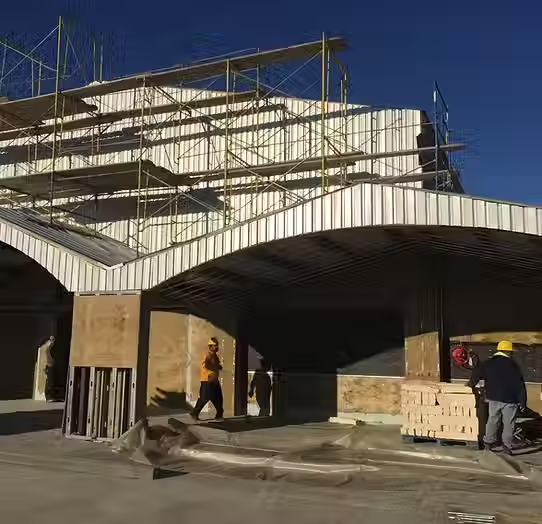
JRH Engineering resolved a complex permitting violation for a manufacturing warehouse owner in Houston, Harris County, Texas, whose building expansion had been constructed without permits.
Project type: Retroactive floodplain permitting
Location: Houston, Harris County, Texas
Site condition: Located within the 500-year floodplain
Services: Civil engineering, floodplain analysis, permitting coordination
The Challenges
The expansion had already been built, with no permits obtained beforehand — placing the owner in violation according to the HOA.
The violation triggered a floodplain compliance review, since the site sat within the 500-year floodplain.
The typical response most engineers default to in this situation is designing new detention — adding significant cost and time the owner couldn't absorb, on top of work already completed.
The Objectives
The owner needed:
A path to compliance that didn't require tearing down or substantially modifying the already-built expansion
.
A floodplain permitting strategy that avoided the cost and schedule of new detention infrastructure, if at all possible.
A resolution that could move through Houston's floodplain administrator review efficiently.
The Solutions JRH Engineering Provided
Value-Based Floodplain Qualification
JRH Engineering conducted a rapid analysis of the unpermitted expansion relative to the existing structure's total assessed value.
The expansion was documented as representing less than 50% of the existing structure's total value
That qualified the project to proceed through the standard floodplain permitting process, rather than a more restrictive substantial improvement review
This distinction changed the entire compliance pathway available to the owner
Existing Detention Capacity Verification
Rather than defaulting to new detention design, JRH Engineering demonstrated that the surrounding neighborhood's existing detention capacity was already sufficient to cover the expansion's drainage impact.
This eliminated the need to design, permit, and build new detention infrastructure
Floodplain compliance documentation was prepared and submitted to satisfy City of Houston floodplain administrator requirements
The Result
Floodplain compliance achieved by qualifying under the 50% substantial improvement threshold
No new detention infrastructure required
A faster, less costly permitting path secured for an already-completed expansion
What This Means for Property Owners in Texas, North Carolina, and Florida
An unpermitted expansion doesn't automatically mean starting over or building costly new infrastructure.
Texas: Substantial improvement thresholds and existing detention capacity analysis can resolve floodplain violations without new construction.
North Carolina: Retroactive permitting often depends on documenting compliance with the applicable local building code and floodplain ordinance.
Florida: Flood zone compliance reviews may have similar value-based thresholds worth investigating before assuming new construction is required.
A civil engineer experienced in floodplain compliance and land development regulations can help evaluate whether an unpermitted structure qualifies for a faster, lower-cost path to compliance.
For general information on substantial improvement and floodplain requirements, see FEMA's Substantial Improvement/Substantial Damage guidance.
For background on local floodplain administration, see the Association of State Floodplain Managers.
Want More Information on this Topic ?
If a property in Texas, North Carolina, or Florida has an unpermitted expansion or floodplain compliance issue, JRH Engineering's team is available to help evaluate the fastest path to compliance.
Call JRH Engineering: (800) 227-9635
Chat now using the chatbot in the lower right-hand corner of this page
JRH Engineering Texas Google Business Profiles:
This article was written by the team at JRH Engineering, a licensed engineering firm with 18 years of experience in civil, structural, and land development. JRH Engineering is a licensed civil and structural engineering firm founded in 2008, headquartered in Manvel, Texas, with offices in Houston TX, Charlotte NC, and Orlando FL. Certified WBE, WOSB, and HUB-eligible. Phone: (800) 227-9635 | sales@jrhengineering.net | jrhengineering.net. Texas PE license is F-10385. North



Comments