


Wind Load Design Requirements for Florida Warehouses
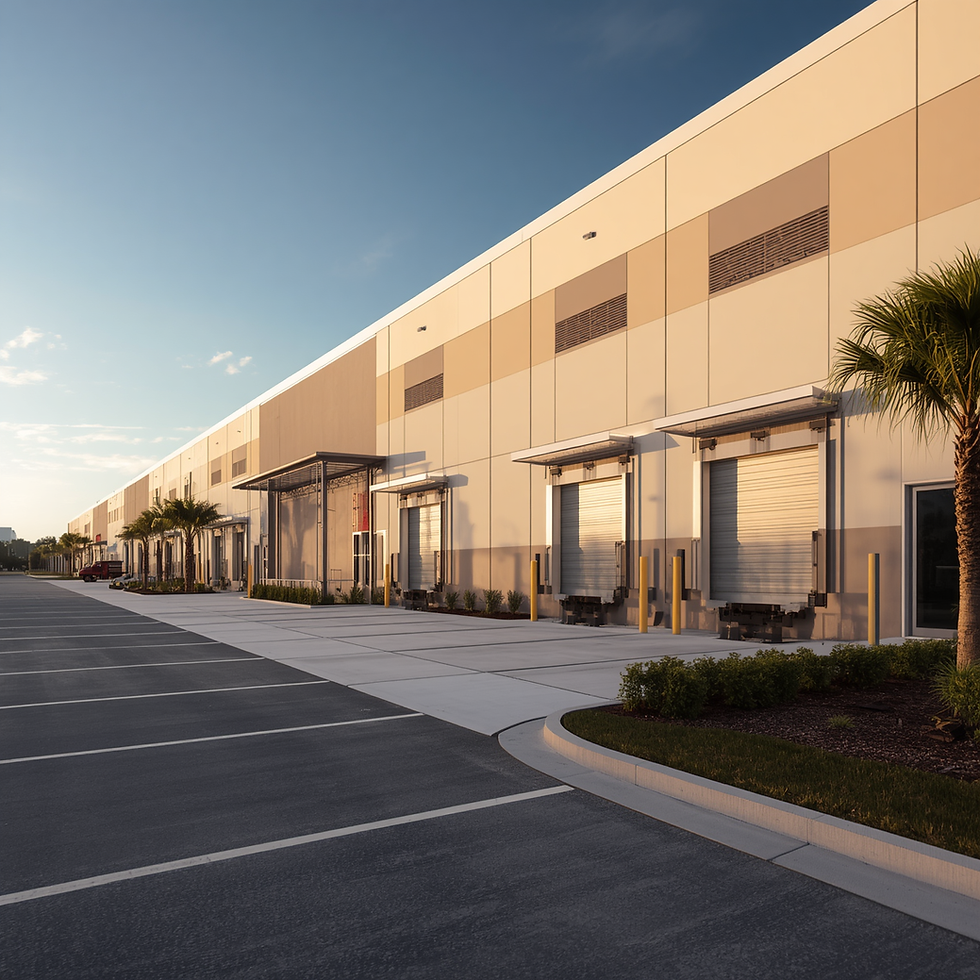
A warehouse roll-up door rated for the wrong wind pressure can change how the entire building is designed.
JRH Engineering is a licensed civil, structural, and land development engineering firm serving Texas, North Carolina, and Florida.
JRH guiding principles are: Engineering Excellence. Delivered on Time. Built on Value.
Here's how Florida Building Code wind load requirements actually apply to a warehouse, using a real Brevard County project as the example.
The Project
JRH Engineering delivered civil and structural design considerations for a 25,000–30,000 SF small-bay warehouse facility in Cocoa, Brevard County, Florida — a tractor-trailer dock-access facility outside the state's High-Velocity Hurricane Zone (HVHZ).
Key project facts:
Location: Cocoa, Brevard County, Florida
Facility type: Small-bay warehouse with tractor-trailer dock access
Wind zone: Outside HVHZ (HVHZ applies only to Miami-Dade and Broward counties)
Governing code: Florida Building Code, 8th Edition (2023), Chapter 16
Services: Civil engineering, site development, structural coordination
The Challenges
Warehouses carry wind design considerations that many commercial buildings don't.
Wind speed is map-based, not fixed, outside the HVHZ. Unlike Miami-Dade and Broward, where wind speed is stated directly in the code, most of Florida — including Brevard County — determines design wind speed from FBC wind speed maps, which vary by location and risk category.
Risk category isn't always obvious. The code doesn't list "warehouse" as its own category. A typical dry-goods or general storage warehouse defaults to Risk Category II, but facilities storing certain toxic or explosive materials above code thresholds can be pushed into Risk Category III or IV, raising the design wind speed considerably.
Large door openings affect the entire building's wind design. Roll-up doors and dock doors are common on warehouses, and if those openings aren't rated for the full design wind pressure, ASCE 7 can require the building to be treated as "partially enclosed" rather than "enclosed" — which increases internal pressure coefficients across the whole structure.
Exposure category has to be verified, not assumed. Open, flat, recently cleared industrial land near highways is common for warehouse sites, and that terrain often supports Exposure C rather than a more sheltered Exposure B — meaning higher design pressures than a quick assumption might suggest.
The Objectives
For a project like this, the goals are generally to:
Confirm the correct wind speed using site-specific coordinates rather than a general assumption
Verify the applicable risk category based on the warehouse's actual use and stored contents
Rate all large door assemblies to the required component-and-cladding pressure, preserving the "enclosed" classification
Confirm exposure category based on actual surrounding terrain conditions
The Solutions JRH Engineering Provided
Site-Specific Wind Speed Verification
Rather than relying on a general figure, wind speed for a non-HVHZ site can be confirmed using the ASCE 7 Hazard Tool, run against the exact site coordinates and confirmed risk category.
Door and Opening Design to Preserve Enclosed Classification
Roll-up and dock door assemblies rated to the required component-and-cladding wind pressure
Enclosed building classification preserved, avoiding the more conservative partially-enclosed design path
FBC's prescriptive nominal pressure table (Table 1609.7) referenced where applicable for eligible buildings
Component and Cladding Review Beyond the Main Structure
Roof and wall components, including metal panels, girts, and purlins common on pre-engineered metal warehouses, checked against higher corner and edge-zone pressures
Rooftop equipment anchorage addressed under ASCE 7 Chapter 29 provisions
Flood-resistant design layered in under Section 1612 and ASCE 24 where the site sits in a flood hazard area
The Result
A wind design approach matched to the site's actual location, terrain, and use
Door and opening design that helped preserve the more favorable enclosed building classification
A structural approach that addressed both wind and, where applicable, flood hazard requirements together
A Code Change Worth Watching
The 9th Edition Florida Building Code is currently in final review and is expected to take effect December 31, 2026, likely aligning with IBC 2024/ASCE 7-22.
This is expected to bring updated wind speed maps and expanded tornado provisions.
Projects with permits submitted close to or after that date should confirm which edition the local building department will be enforcing.
Does Wind Load Design Matter Outside Florida?
Wind load design isn't only a Florida consideration.
Texas: Gulf Coast and coastal Texas sites can carry similar high-wind design requirements, particularly near the coastline.
North Carolina: Coastal counties can carry elevated wind design requirements under the NC State Building Code.
Florida: As outlined above, wind design varies significantly by county and by HVHZ status.
A structural engineer familiar with the applicable state and county code can help confirm wind design requirements before a project moves into permitting.
For site-specific wind speed verification, see the ASCE 7 Hazard Tool.
For Florida Building Code information, see the Florida Building Commission.
For flood-resistant design standards referenced alongside wind provisions, see FEMA.
Want More Information on this Topic?
If a warehouse or industrial project in Florida, Texas, or North Carolina needs civil engineer or structural engineer review of wind load and land development requirements, JRH Engineering's team is available to help.
Call JRH Engineering: (800) 227-9635
Chat now using the chatbot in the lower right-hand corner of this page
Or contact JRH Engineering online
JRH Engineering Google Business Profiles:
This article was written by the team at JRH Engineering, a licensed engineering firm with 18 years of experience in civil, structural, and land development. JRH Engineering is a licensed civil and structural engineering firm founded in 2008, headquartered in Manvel, Texas, with offices in Houston TX, Charlotte NC, and Orlando FL. Certified WBE, WOSB, and HUB-eligible. Phone: (800) 227-9635 | sales@jrhengineering.net | jrhengineering.net. Texas PE license is F-10385. North Carolina PE license is P-3118. Florida license is 38516.



Comments